← Insurance
PIRCInsurance rating & pricing

Pulsar Insurance Rate Calculator

No-code rating, an AI actuary and governed pricing for every line of insurance.

PIRC lets actuaries build, test, approve and publish rating plans without code — then serves them by API, learns from experience data, and proposes the next rate change for human approval. The rating plan itself becomes the product: factor tables and a step-by-step algorithm that actuaries edit, version and approve under maker-checker, run by a deterministic engine that explains every price.

Pulsar Insurance Rate Calculator rating plan workbench
16line templates ship with working rating logic
20rating step types on one deterministic engine
480+automated checks, including independently recomputed worked examples

Overview

At a glance

01

No-code rating workbench

Factor tables and a step-by-step algorithm per coverage, edited on screen, versioned and approved under maker-checker.

02

Rating API with every term

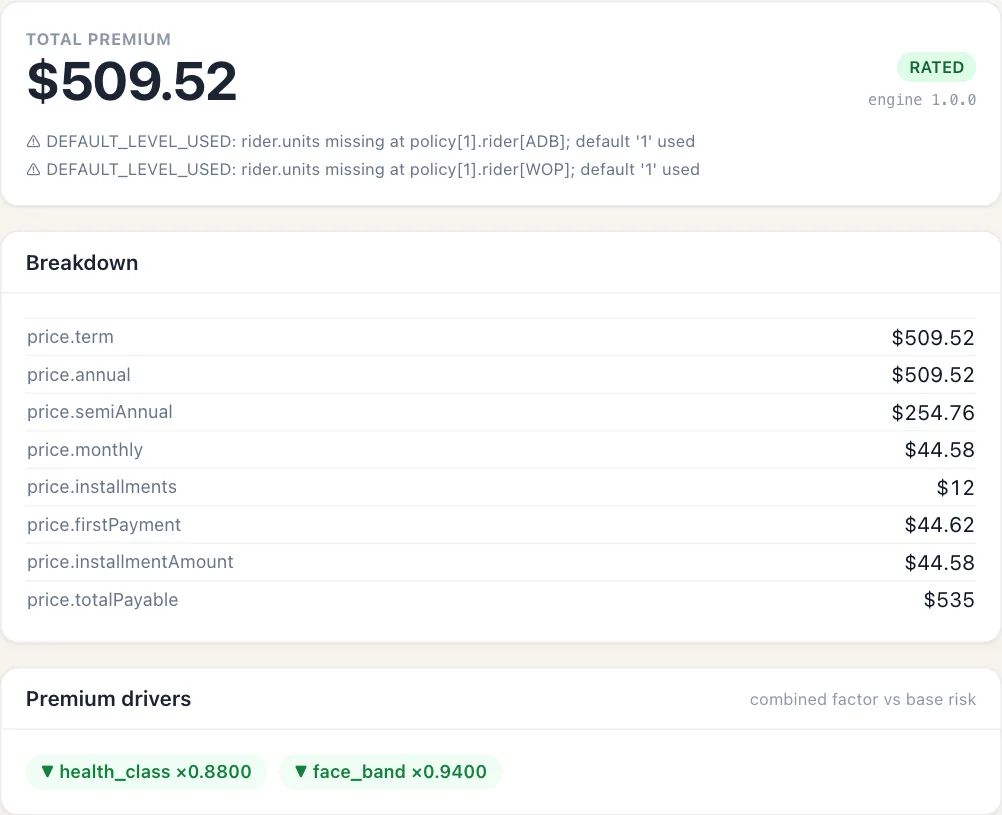
One call returns the price with its drivers; annual, 6-month, monthly and the instalment schedule come from the same plan.

03

AI actuary

Re-estimates relativities from your own experience data and delivers a draft rate plan, with its evidence and gates, for a person to approve.

04

Impact Lab

Re-rates the in-force book under any draft: who moves, by how much, and a solver that lands the book on an overall rate target.

05

Any line, one engine

Auto, property, life, disability, dental, vision and group medical are configuration on the same engine, not new code.

Capabilities

What makes it different

Seven capabilities that compound — the workbench actuaries use, the API systems call, and the AI, impact and monitoring tools that keep a rating plan current.

01

No-Code Rating Plan Workbench

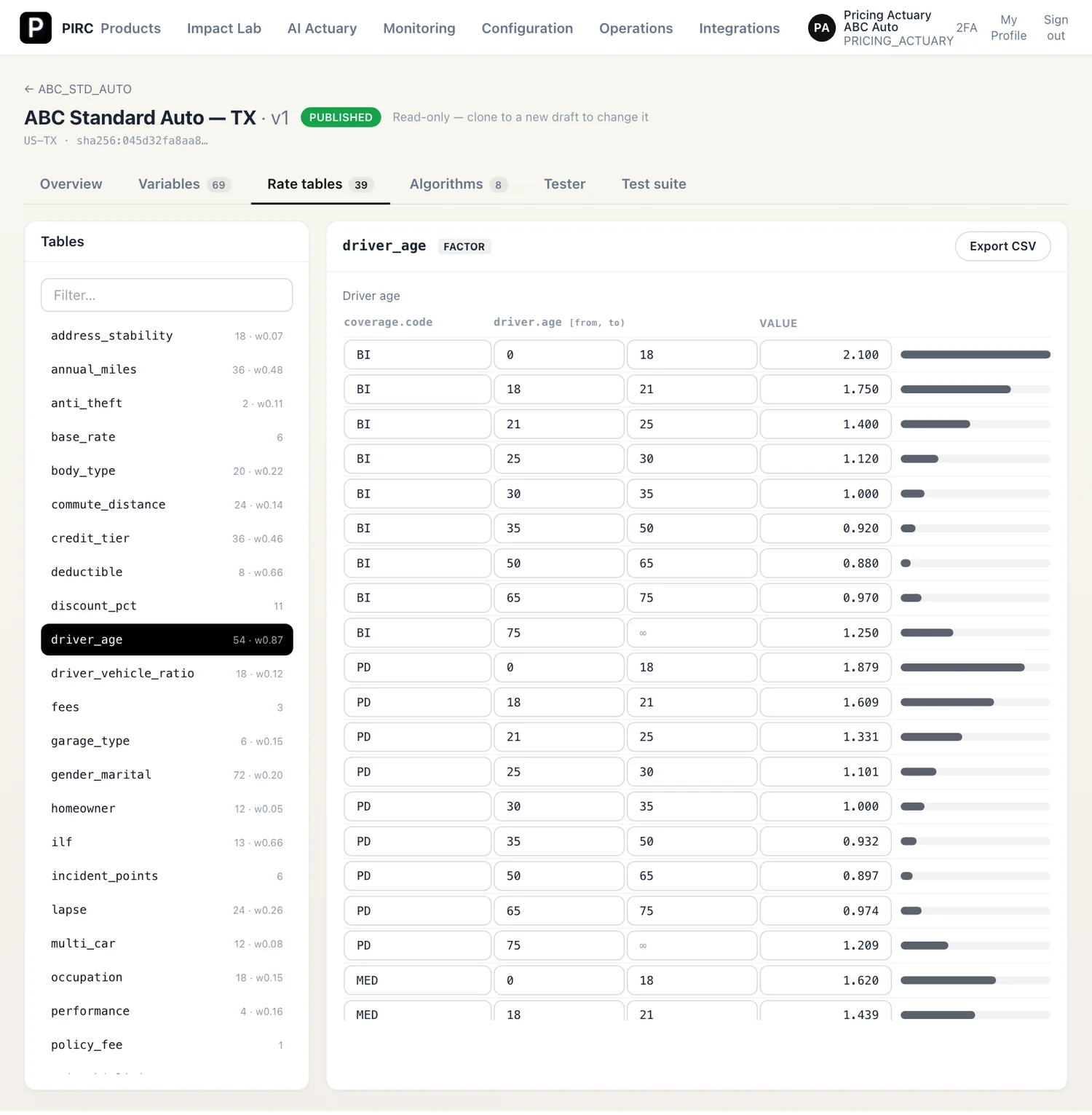
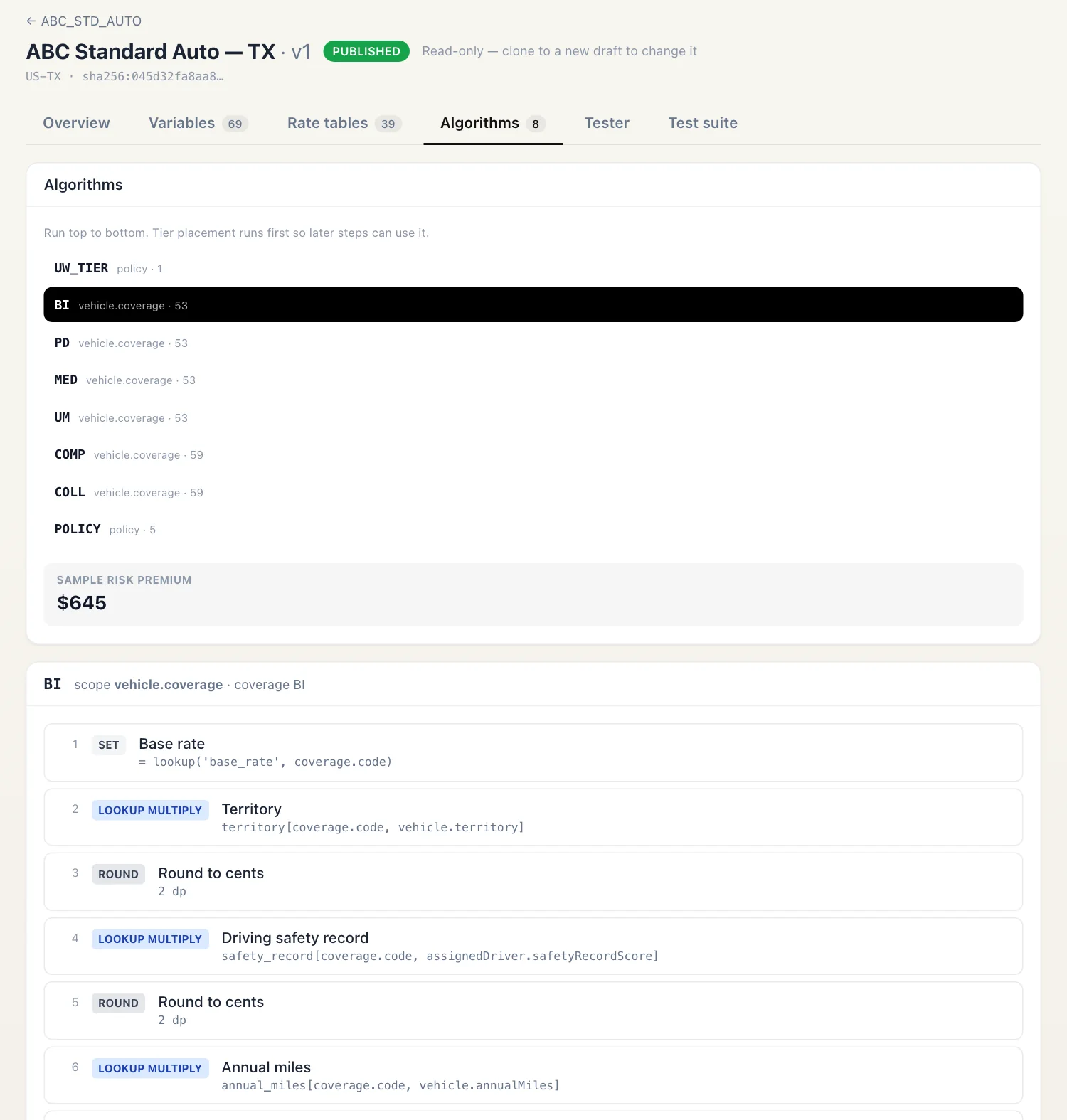
A rating plan is data an actuary edits, not code a developer ships. Factor and rate tables hold the relativities; an algorithm per coverage chains steps — base rate, lookups, rounding, discounts, scorecards, schedule rating, fees, minimum premiums, retention and tier conversion — drawn from a fixed set of 20 step types. Every plan has a tester with a what-if sweep and a test suite of expected prices, and it is checked against the jurisdiction’s rules before it can be submitted.

Why it matters
  • A rate change, a new state or a new product is a configuration job done by the pricing team, not a development ticket
  • The same 20 step types rate every line, so any actuary can read a plan — there is no custom code to audit for each product
  • A draft that changes prices fails its test suite until the actuary reviews and accepts each changed price, version by version
No-Code Rating Plan Workbench
02

Rating API: Annual, 6-Month & Monthly Prices

One call to the rating API returns the price with its drivers, any underwriting refer or decline, and a full worksheet. The plan prices its natural term and a billing block turns that into what the customer asks for: annual, six-month and monthly prices plus the instalment schedule, with down payment, surcharge and fee. Quotes, binds, cancellations and claims flow back through feeds that reject bad records with a reason, and any logged call can be replayed to the identical result.

Why it matters
  • Policy-administration, quoting and agent systems call one governed price instead of re-implementing rating in each channel
  • Term factors and billing plans are tables the actuary edits, so a new payment plan or term never needs a code change
  • Every logged call replays bit-for-bit on the version that priced it — 10,000 production-path calls replayed identically in testing
Rating API: Annual, 6-Month & Monthly Prices
03

Every Line of Insurance on One Engine

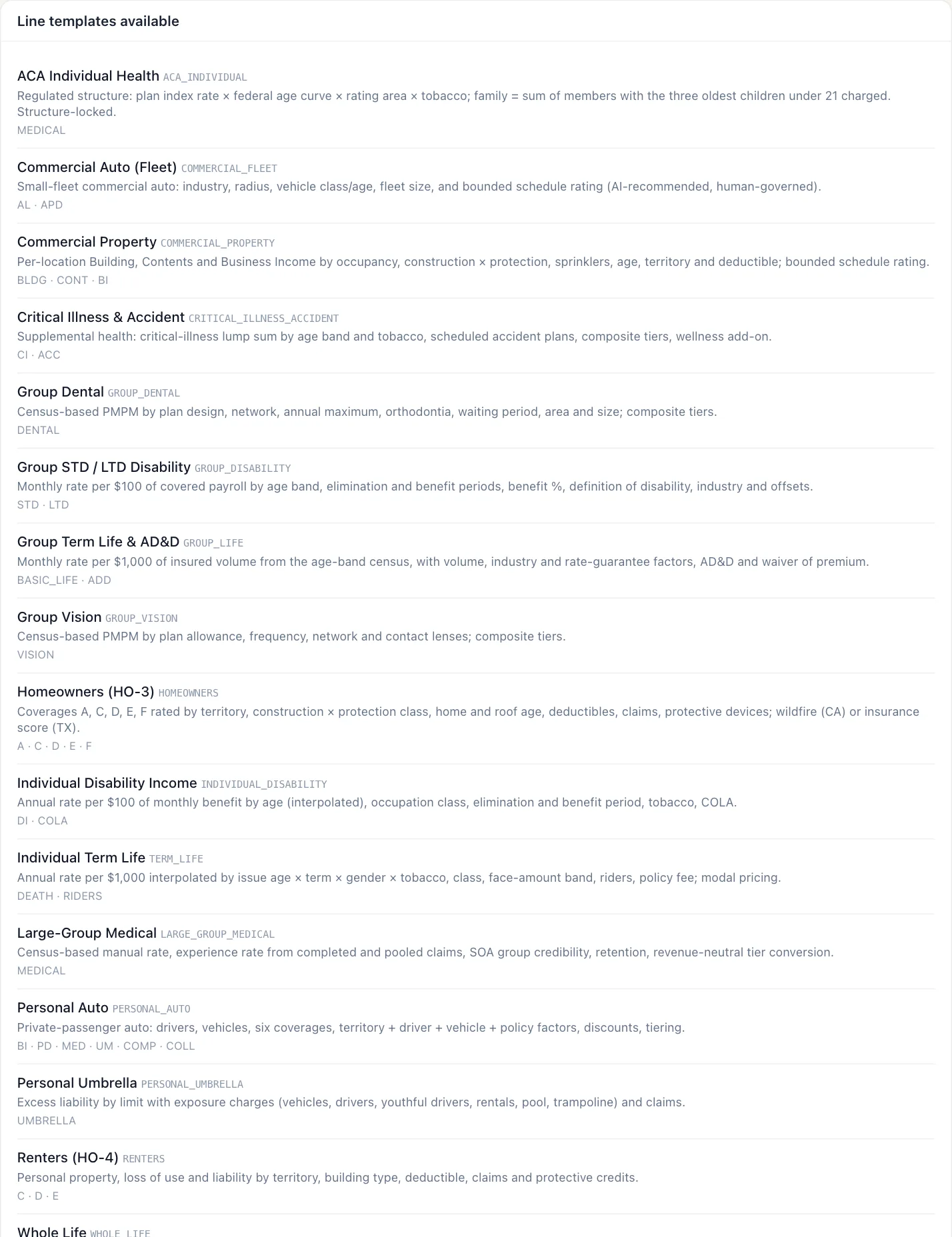
Sixteen line templates ship with working rating logic, underwriting rules and billing: personal and commercial auto, homeowners, renters, umbrella and commercial property; term life, whole life, individual disability, and critical illness and accident; group life, group disability, dental, vision and large-group medical; and a structure-locked ACA individual plan. Template factors are illustrative starting points, not filed rates. A new line is tables and steps on the same engine.

Why it matters
  • Launch a new line or state as a copy of a template that already rates, tests and bills, then change the factors
  • Underwriting outcomes, term and billing options and regulated structures such as the ACA age curve are built in per line
  • Each template’s prices were recomputed independently in testing and match to the cent
Every Line of Insurance on One Engine
04

AI Actuary: Rate Proposals from Your Own Experience

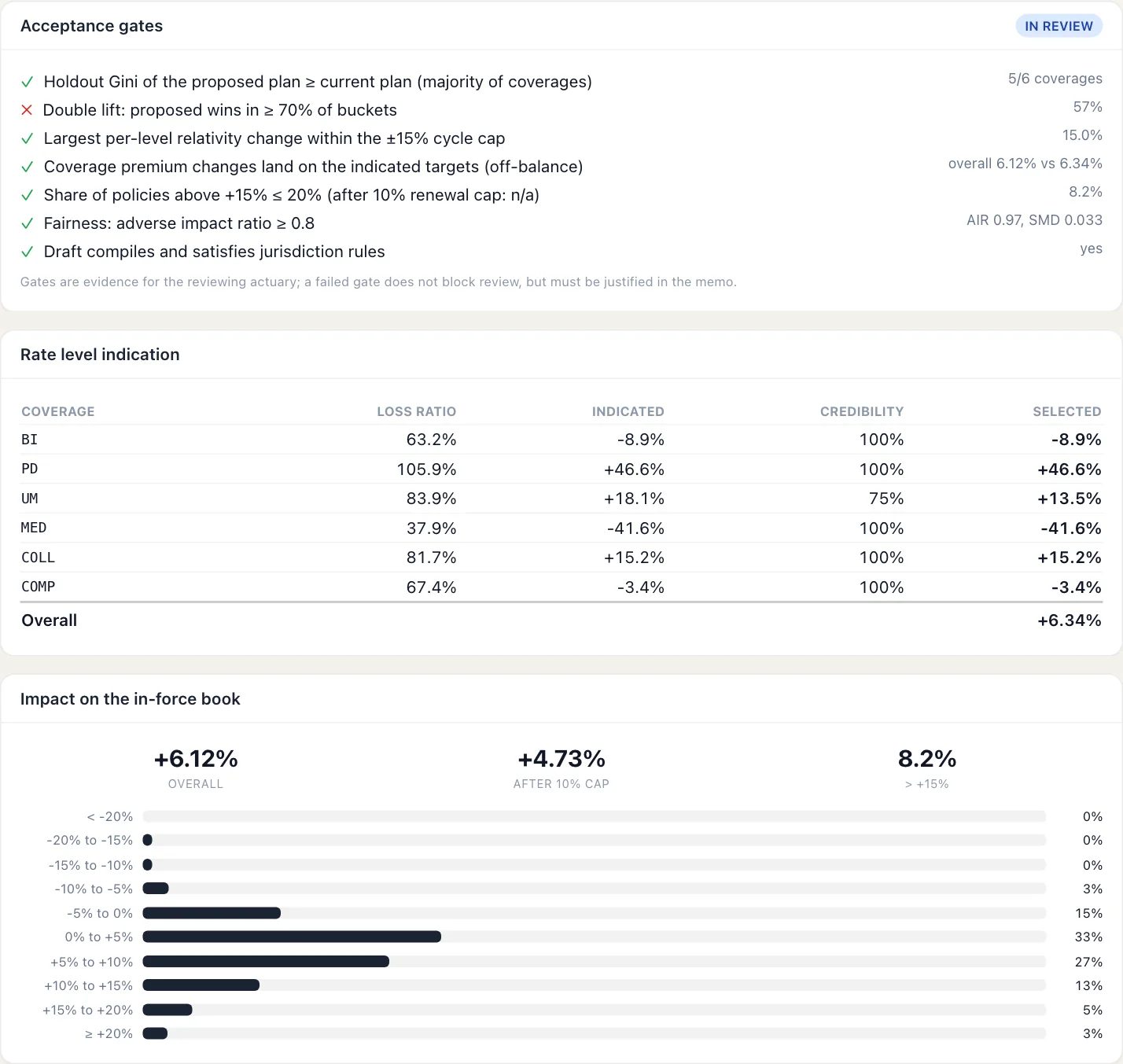
From human-confirmed assumptions, the AI actuary fits statistical models to your claims and exposure, tests every rating table against its current relativities, applies credibility and a change cap, and builds a draft plan with a filing package. Each run reports its acceptance gates — holdout Gini, double lift, off-balance, share of policies up over 15% — with their values; a failed gate is shown, never hidden. It works on auto, property, life, disability, dental, vision and group medical.

Why it matters
  • On a hidden planted truth, 94% of 481 credible auto levels fell inside the 95% interval and 14 of 17 changed tables moved toward it
  • The AI only writes a draft; unconfirmed assumptions are refused and a credentialed approver publishes
  • Factors with no real effect are left alone, and drafts are repaired to meet state rules such as California’s
AI Actuary: Rate Proposals from Your Own Experience
05

Impact Lab & Off-Balance Solver

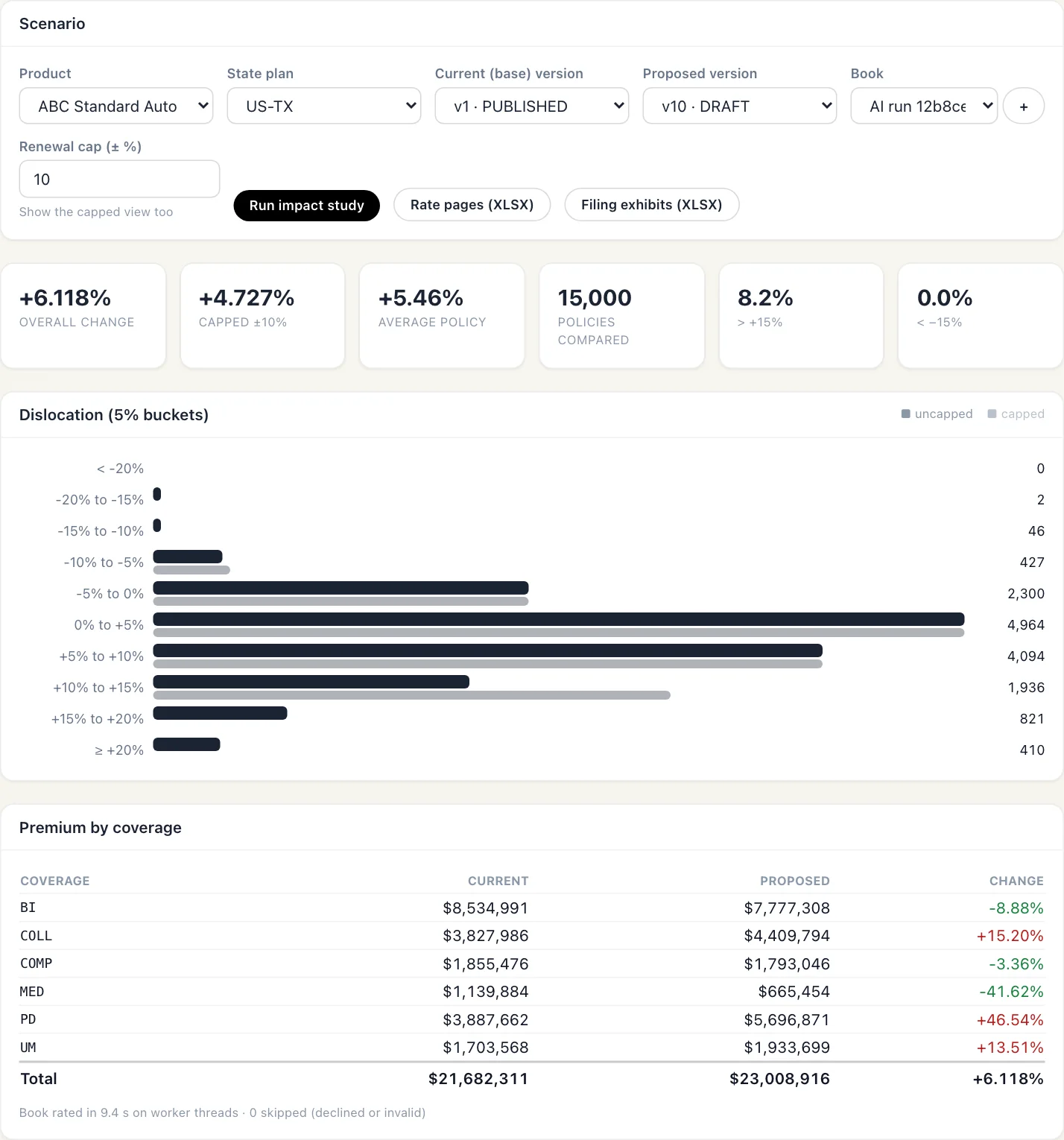
Re-rate a sample of the in-force book under the current and a proposed version and see who moves and by how much: overall and capped change, a 5% dislocation histogram, premium by coverage, largest increases and decreases, and any segment. Then set a target — say +3.0% overall — and the solver adjusts base rates through the real engine, with rounding, caps and discounts included, until the book lands on it. Rate pages and filing exhibits export to Excel.

Why it matters
  • Every number is produced by the production engine on real policies, and was recomputed independently in testing
  • On a 100,000-policy book the solver took a +6.19% draft to +3.002% against a +3.000% target in 132 seconds
  • A renewal cap shows the uncapped and the capped view side by side, so the dislocation agents and regulators will feel is visible before filing
Impact Lab & Off-Balance Solver
06

Governed by Design

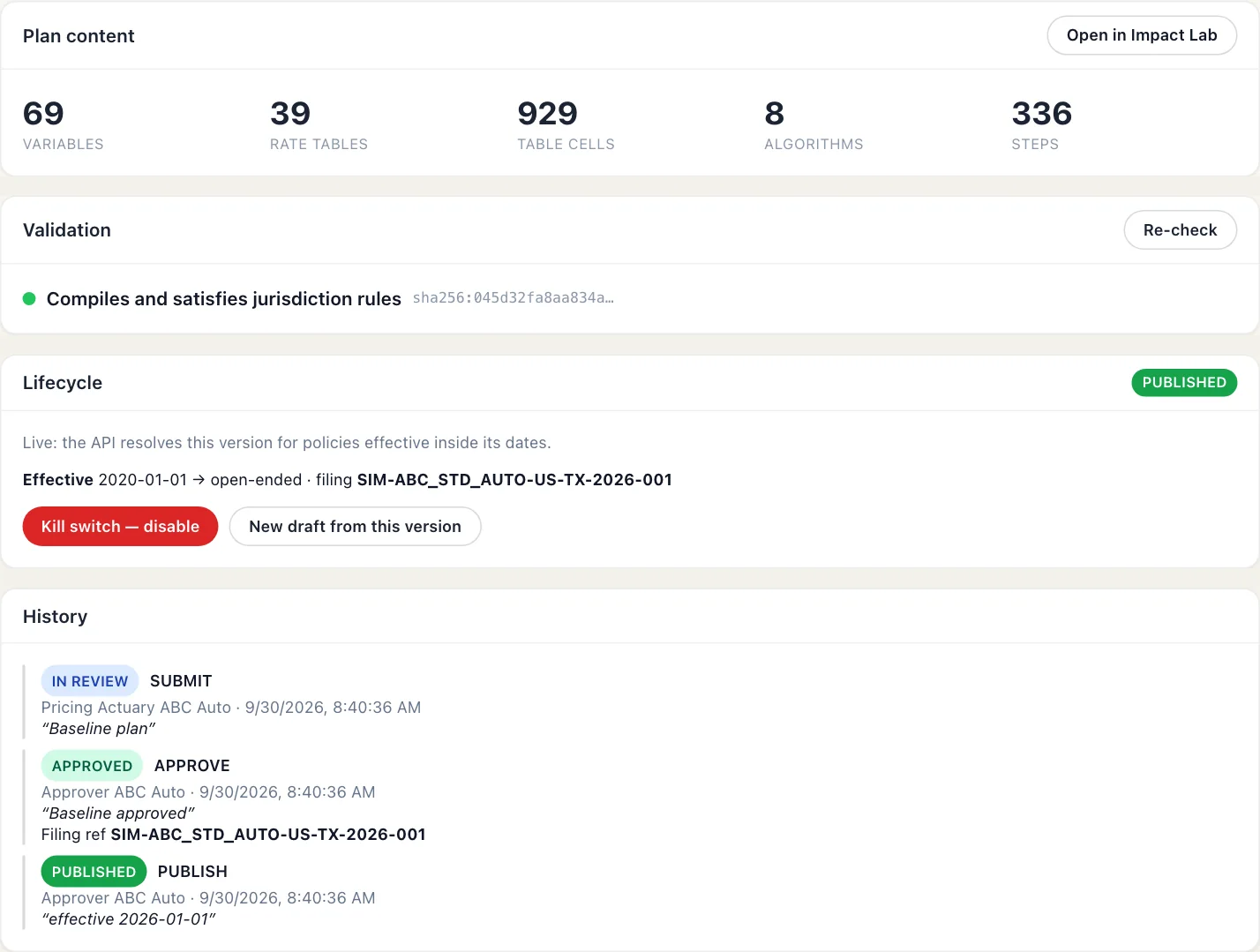
A version moves through draft, in review, approved and published, and once published it is frozen — a change means a new draft. Submitting and approving re-check the plan against the jurisdiction’s rules, and the approver must be a different person from the author and the submitter. Every step is written to a hash-chained audit log; a kill switch disables a live version at once, and structure locks keep a regulated plan such as ACA within its regulated form.

Why it matters
  • Rules a regulator owns are checked every time a version is compiled, submitted or approved, and each tenant can add stricter rules of its own
  • Published versions are immutable — enforced in the database — and carry their filing reference and approval history
  • The audit trail is hash-chained so tampering is detectable, and the chain is verified in testing after every kind of event
Governed by Design
07

Experience Monitoring & Bounded AI Schedule Rating

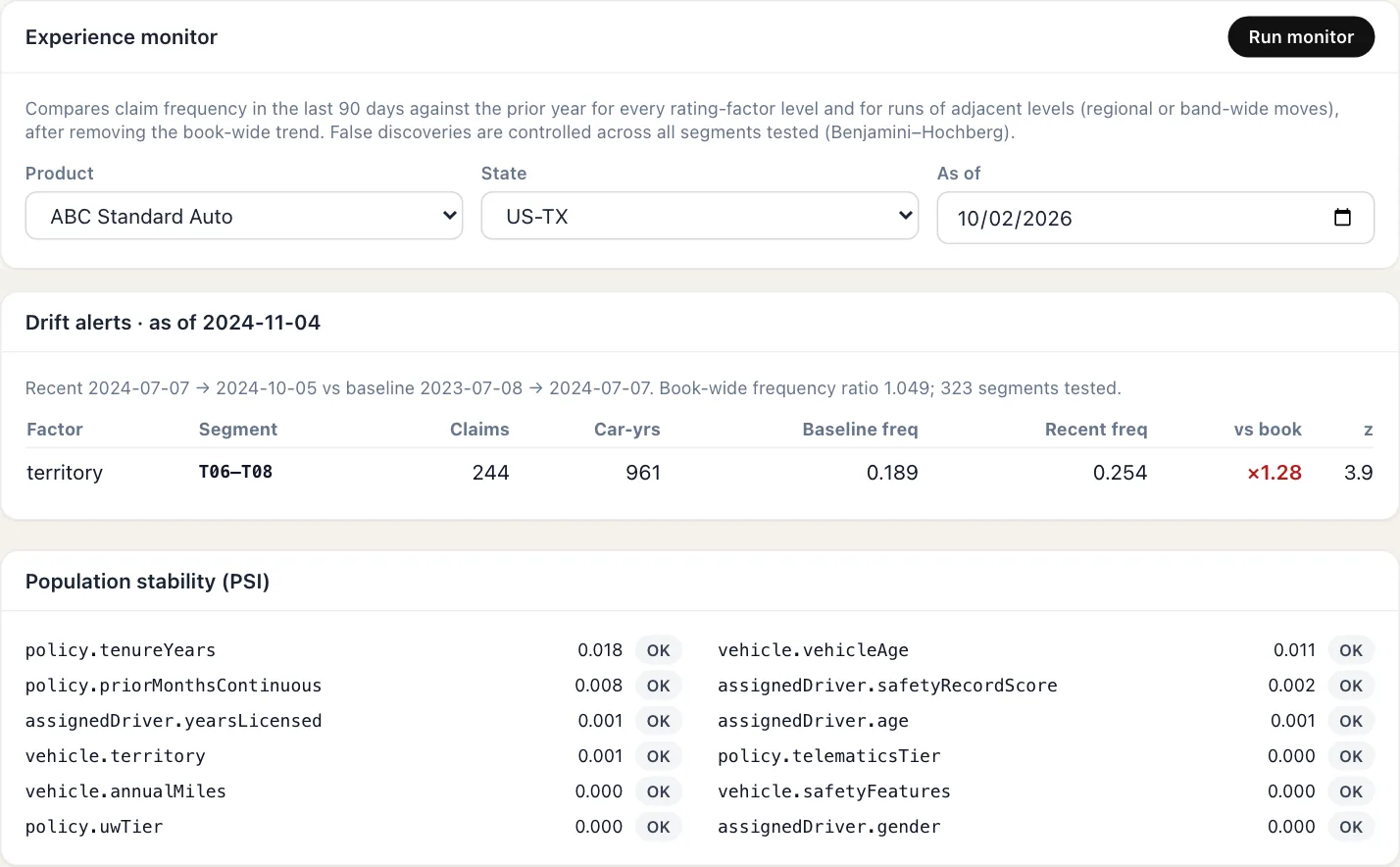
Once a plan is live, the monitor compares the last 90 days of claim frequency with the prior year for every rating-factor level and for runs of adjacent levels, after removing the book-wide trend, and controls false discoveries across every segment tested. For commercial lines, an AI recommends schedule-rating adjustments inside the bounds the filing allows, cross-checked against a deterministic baseline; a disagreement goes to a person.

Why it matters
  • Finds shifts in groups of adjacent territories or bands that no single level could show on its own
  • In testing it stayed silent through twelve runs, then flagged a planted +25% territory shift with no unrelated alerts
  • Schedule-rating adjustments are bounded three times — in the prompt, by the recommender and by the engine — and a sign disagreement with the baseline goes to a person
Experience Monitoring & Bounded AI Schedule Rating

Built in

Also built into PIRC

Beyond the seven core capabilities, PIRC ships the operating controls a rating and pricing team needs on day one.

Version Test Suites

Expected-price cases per version; a draft’s price changes are reviewed and accepted case by case.

What-If Sweeps

Vary one input in the tester and see the price curve before changing a table.

Filing Exhibits

Rate pages and filing exhibits export to Excel from any version.

Kill Switch & Replay

Disable a live version at once; replay any logged rating call exactly.

Structure Locks

Regulator-owned structures, such as the ACA age curve, cannot be loosened from the screen.

Tenant Configuration

Jurisdiction rules, AI, monitoring and data-provider settings per tenant and product, validated and audited.

Data Enrichment Hooks

VIN decode, insurance-score tier and telematics before rating; simulated providers ship.

Tenants, Roles & Keys

Isolated insurers, role-gated screens, TOTP login, and API clients with their own keys and rate limits.

Who it’s for

Who it’s for

Insurance organizations whose rating logic lives in policy-administration code, spreadsheets and filing PDFs — so a rate change is a development project and no one can replay what was quoted, or why.

CarriersRate auto, property, life, disability and group lines on one governed engine, and serve prices to quoting and policy systems by API.
MGAsLaunch a new program, state or filing as configuration on a working template instead of a development project.
TPAs & group administratorsGroup life, disability, dental, vision and large-group medical templates ship ready to configure.
Actuarial & pricing teamsEdit factor tables and algorithm steps directly — versioned, tested and auditable — and let the AI actuary draft the next rate change for approval.

Architecture

Under the hood

How PIRC is built

Configuration-first and deterministic by design — rating plans are data the engine reads, every price is replayable, and the AI only ever proposes drafts.

01PresentationRole-gated workbench in the Pulsar web app
Plan WorkbenchProducts, variables, rate tables, algorithms, tester, test suite and the version lifecycle
Impact Lab & AI ActuaryBook studies, the off-balance solver, and AI runs with their gates and memo
Monitoring & ConfigurationExperience monitor, schedule-rating decisions, tenant settings, operations, integrations
02API & IntegrationThe public rating API and the feeds behind it
Rating API (/v1)Rate, batch rate, replay and input schemas; per-client keys and rate limits
Outcome & Claims FeedsQuote, bind, renewal, cancel and claim records, validated with a reason on every rejection
Admin APIProducts, versions and lifecycle, impact studies, AI runs, monitoring, settings and audit
03Decision & AnalyticsDeterministic rating, statistical modelling
Rating EnginePure and deterministic; 20 step types, 34-digit decimals, worksheet and premium drivers
Rules & LocksJurisdiction rules, regulator-owned structure locks, underwriting refer and decline
Modelling ServiceGLM and loss-cost models with joint tests and out-of-time validation
Impact & SolverRe-rates the book through the real engine and solves base rates to a target
04Data & AuditPostgreSQL, immutable versions, replayable history
Plans & VersionsFrozen published versions; compiled programs addressed by hash
Rating Log & Data MartEvery call logged for replay; exposures, claims, triangles and confirmed assumptions
Hash-Chained AuditAppend-only events with the actor and before/after on every configuration change
05IntegrationFits the systems you already run
Policy Admin & QuotingCall /v1/rate and post binds; no rating logic is left in the channel
Claims SystemPosts claims and valuations that feed the experience data mart
Data ProvidersVIN decode, insurance-score tier and telematics; simulated providers ship
LLM (optional)Narrative memo and schedule-rating recommender; the models are statistical

Talk to us about Pulsar Insurance Rate Calculator.

Get in touch