← Mortgage
PCSCustomer service & collections

Pulsar Customer Service

Compliance-aware customer service, collections & SPOC for mortgage servicers.

PCS is the compliance-aware front office for mortgage servicing — customer service, collections and single-point-of-contact work built into the Pulsar Servicing Platform, not bolted on beside it. Every call, task and callback is decided against the live loan record, with the rules held as admin-editable data and every decision audited.

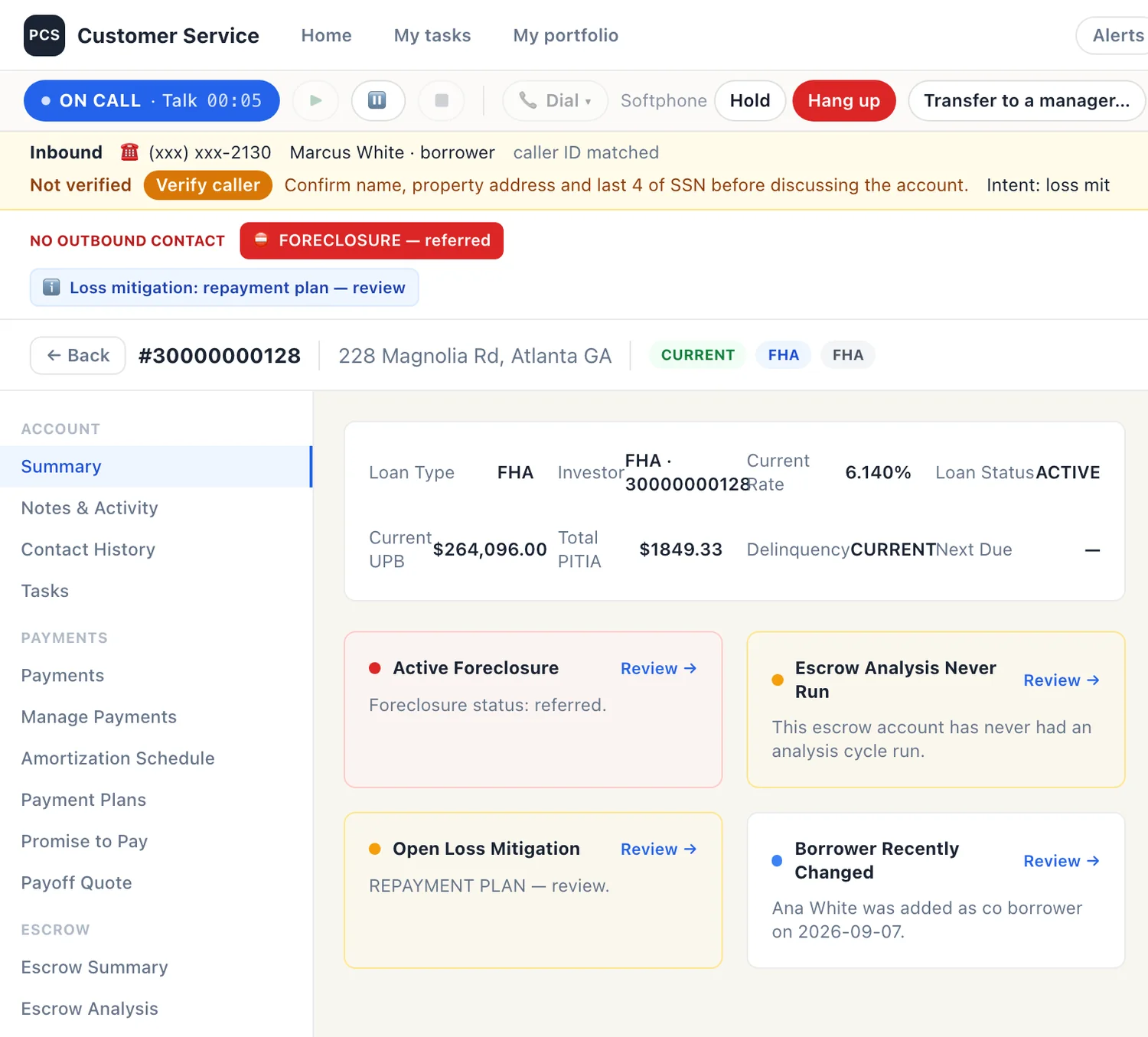
Pulsar Customer Service agent desktop with contact-policy banners
140+API endpoints
20+standard operations and compliance reports
50 statesplus DC and PR calling rules, each tracked as reviewed

Overview

At a glance

01

Contact Policy Decision Point

Every dial, task and callback is checked server-side against bankruptcy, foreclosure, litigation, do-not-call, Reg F and state-hour rules held as editable data.

02

Investor-rule SPOC cadence

Fannie Mae, Freddie Mac, FHA, VA and USDA contact cadences run as rule sets that create the next call task automatically.

03

Area-based, skill-aware routing

Work is load-balanced across every team in an area, and a Spanish-speaking caller is never routed to an agent without the skill.

04

Role-based panel, task-driven change

One shared loan panel with edit rights set per role and area; every change to loan data is an audited task with an owner and an SLA.

05

Vendor-neutral telephony

PCS owns the business decisions; your contact-center platform and dialer plug in behind an adapter.

Capabilities

What makes it different

The compliance, routing and workforce capabilities that neither a generic contact center nor a servicing core provides on its own.

01

Contact Policy Decision Point

One server-side decision answers every “may we contact this borrower?” question. Click-to-dial, cadence tasks and the red, amber and blue loan-screen banners all read one admin-editable rule set, evaluated against live loan facts — cease and desist, attorney, bankruptcy, foreclosure, litigation, deceased borrower, do-not-call, an active promise to pay — plus the Reg F 7-in-7 limit and each state’s calling hours. The browser sends a phone ID, never a number.

Why it matters
  • A policy change — a new state rule, a refined bankruptcy carve-out — is a rule edit by compliance, not a development ticket
  • Blocks are enforced on the server for every dial and task, and a built-in tester shows exactly why a call is blocked — evidence an examiner can follow
  • Optional maker-checker: a second approver signs off before a compliance rule change takes effect, with before and after audited
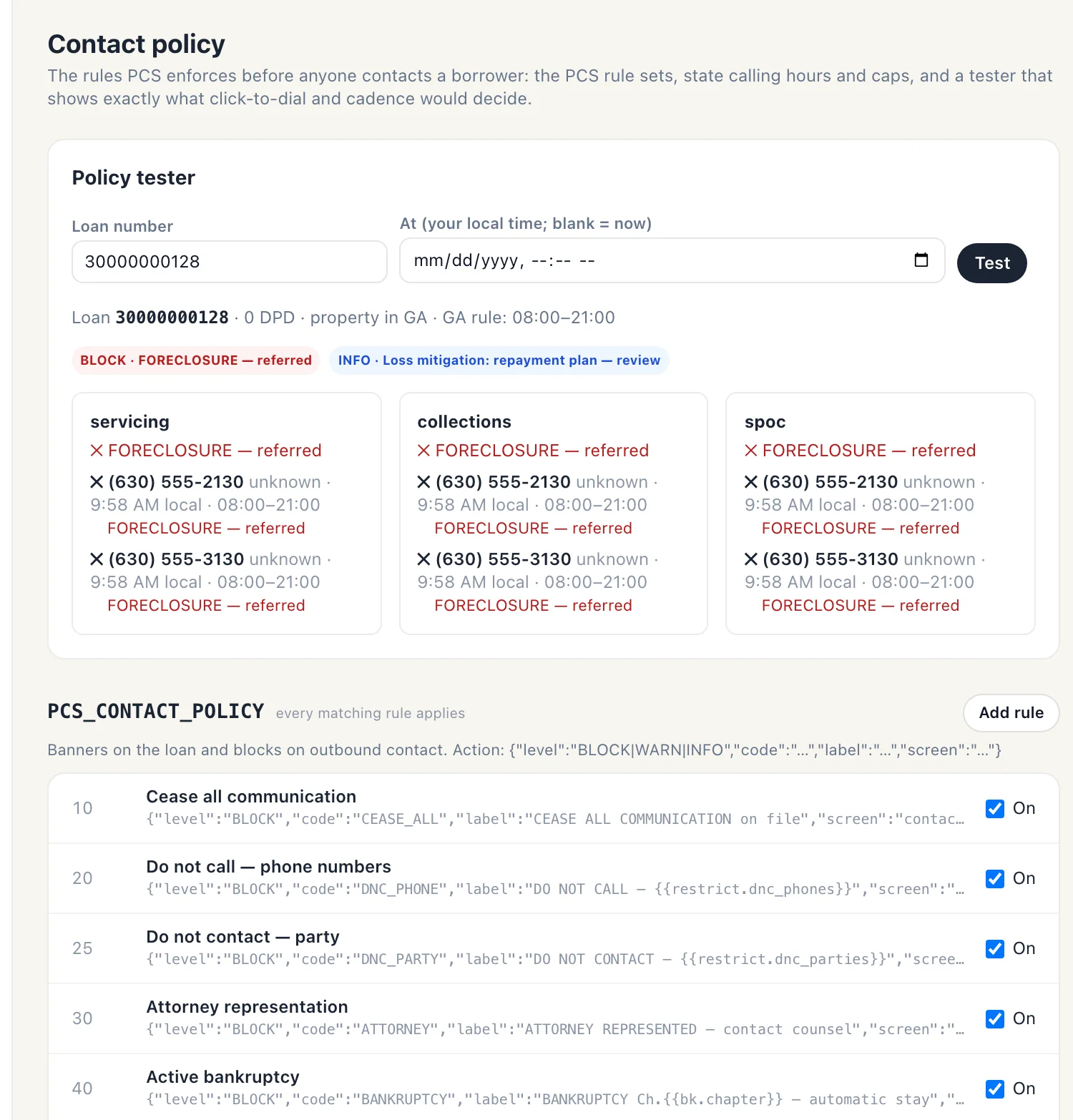
Contact Policy Decision Point
02

Investor-Rule SPOC Cadence Engine

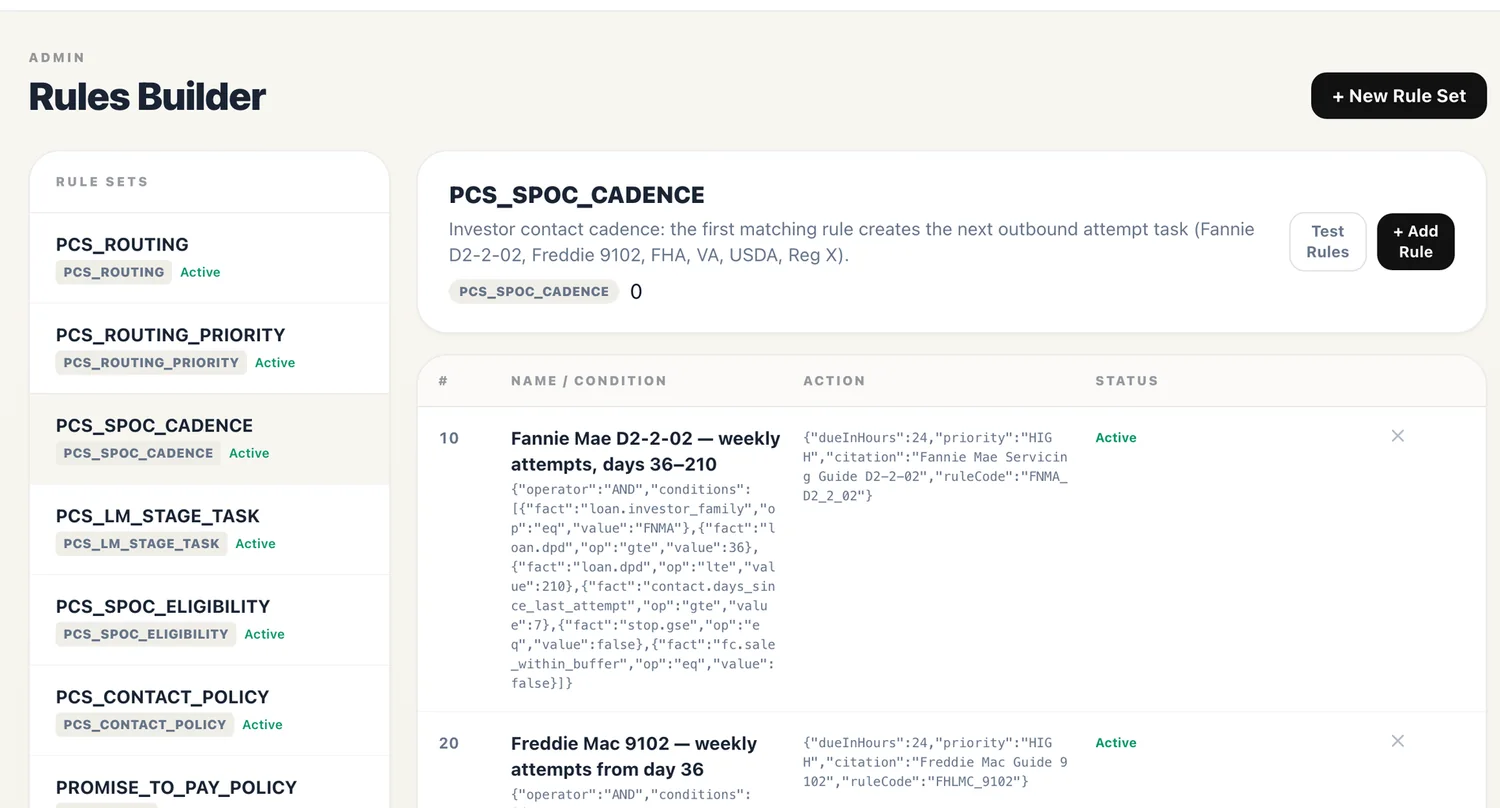
Reg X requires a single point of contact, and investors dictate how often a delinquent borrower must be called. PCS keeps both as data: cadence rules for Fannie Mae, Freddie Mac, FHA, VA and USDA decide when the next outbound attempt is due and create exactly one call task per loan per rule. A new SPOC is chosen by portfolio balance, keeps continuity across cases, and is written to PSP — and to Loss Mitigation, when deployed — through their public APIs.

Why it matters
  • An investor cadence change is a rule edit, not a release — and every task created carries the rule and citation that fired it
  • A task is suppressed, and logged as suppressed, when contact policy blocks the call — cadence can never force an illegal attempt
  • Works with or without Loss Mitigation: the SPOC trigger is a case event, a delinquency day or a PSP loss-mit case — one setting
Investor-Rule SPOC Cadence Engine
03

Area-Based, Skill-Aware Routing

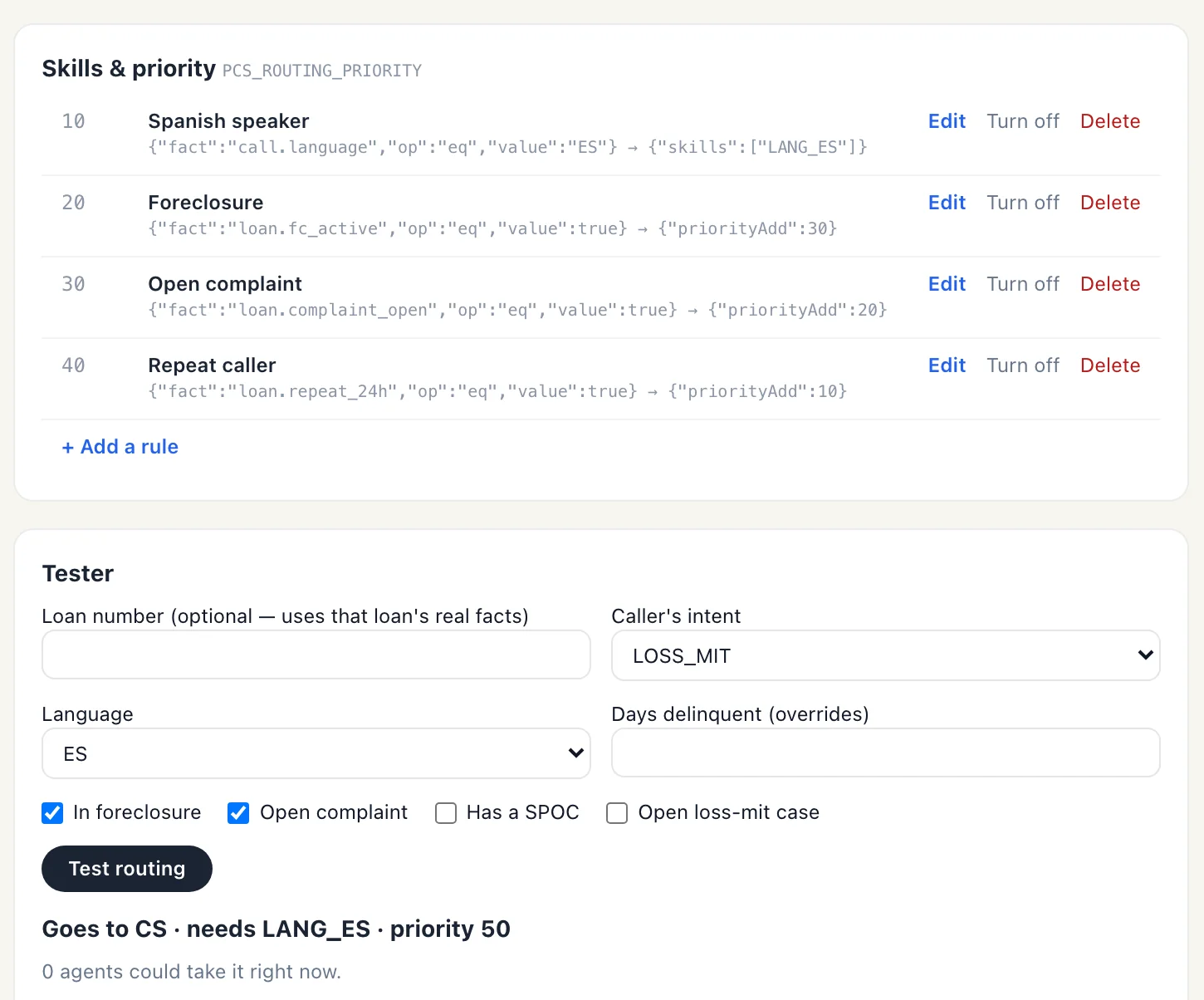
Work is routed to an area — Customer Service, Collections, SPOC — and load-balanced across every team currently placed in it, not to a fixed team. Inbound calls are routed from a live data dip: language, days delinquent, an active foreclosure, an open complaint, a repeat call within 24 hours or an assigned SPOC all steer the decision. Spanish is a hard requirement — a Spanish-speaking caller waits for a qualified agent rather than reaching an unqualified one.

Why it matters
  • Moving a team between areas is one admin action — its role, work scope and routing follow on the next decision, with a placement history
  • Routing and priority are editable rule sets with a built-in tester, so a supervisor sees where a call would land before changing a rule
  • Assignment weighs open tasks and PSP service requests by effort and part-time weight, so no agent is silently overloaded
Area-Based, Skill-Aware Routing
04

Vendor-Neutral Telephony & End-Call Discipline

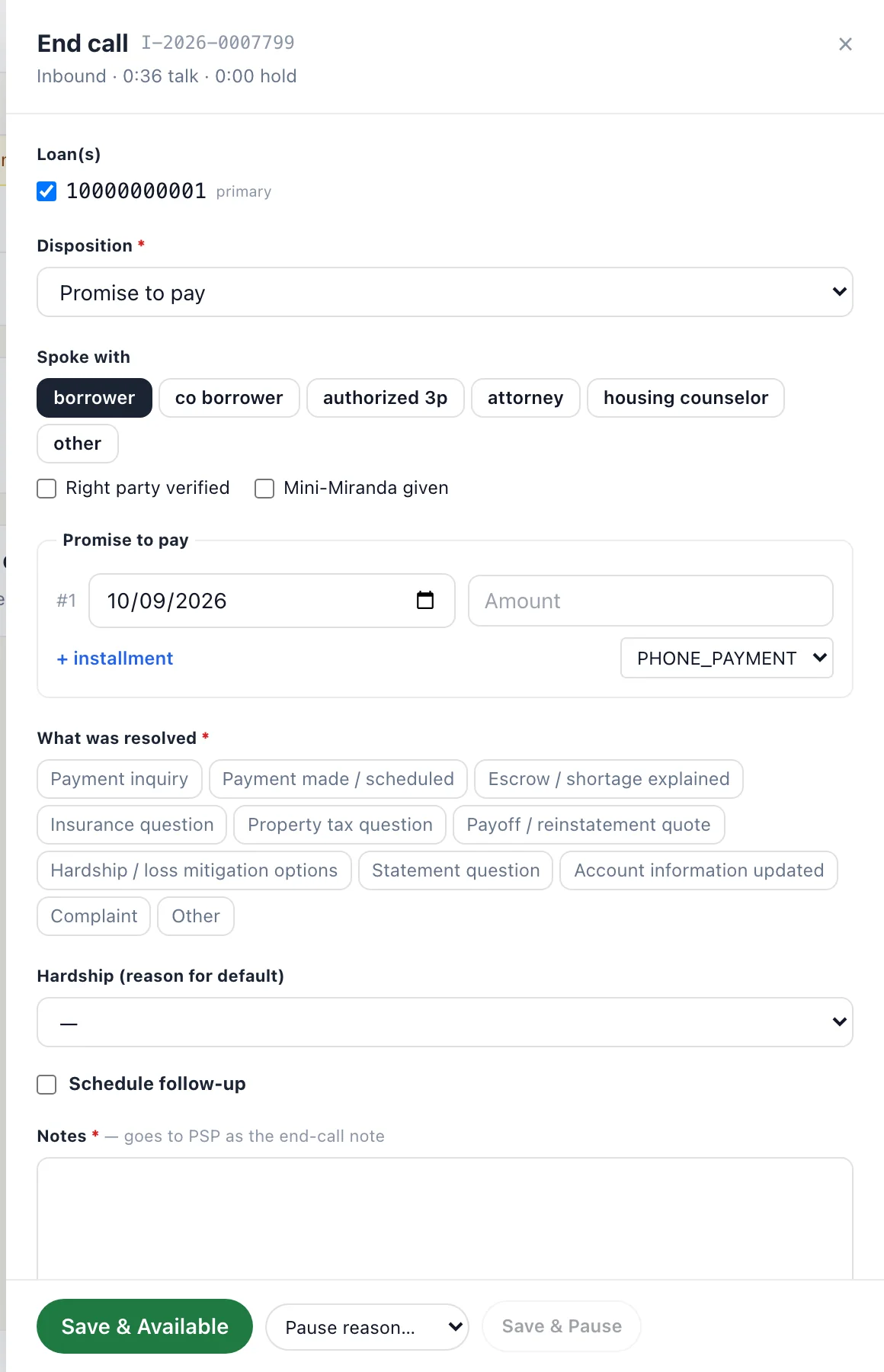
PCS makes the business decisions — routing, agent state, the click-to-dial check, the disposition — and a signed-webhook adapter lets your contact-center platform carry them out. An agent stays On Call until the End Call disposition is saved; one transaction stores the data, then a durable outbox posts one summary note to PSP, so a PSP outage never traps an agent. A phone simulator ships today; a live adapter is built to your platform.

Why it matters
  • No phone-vendor lock-in: media and dialing stay with the contact-center platform; compliance logic stays with PCS
  • End-call data — disposition, who was spoken with, right-party check, Mini-Miranda, resolution, promise — is captured per call
  • Vendor webhooks are HMAC-signed; the IVR data dip is tested to a sub-300 ms p95 and a 300-call, 40-agent day runs end to end
Vendor-Neutral Telephony & End-Call Discipline
05

Real-Time Operations Reporting

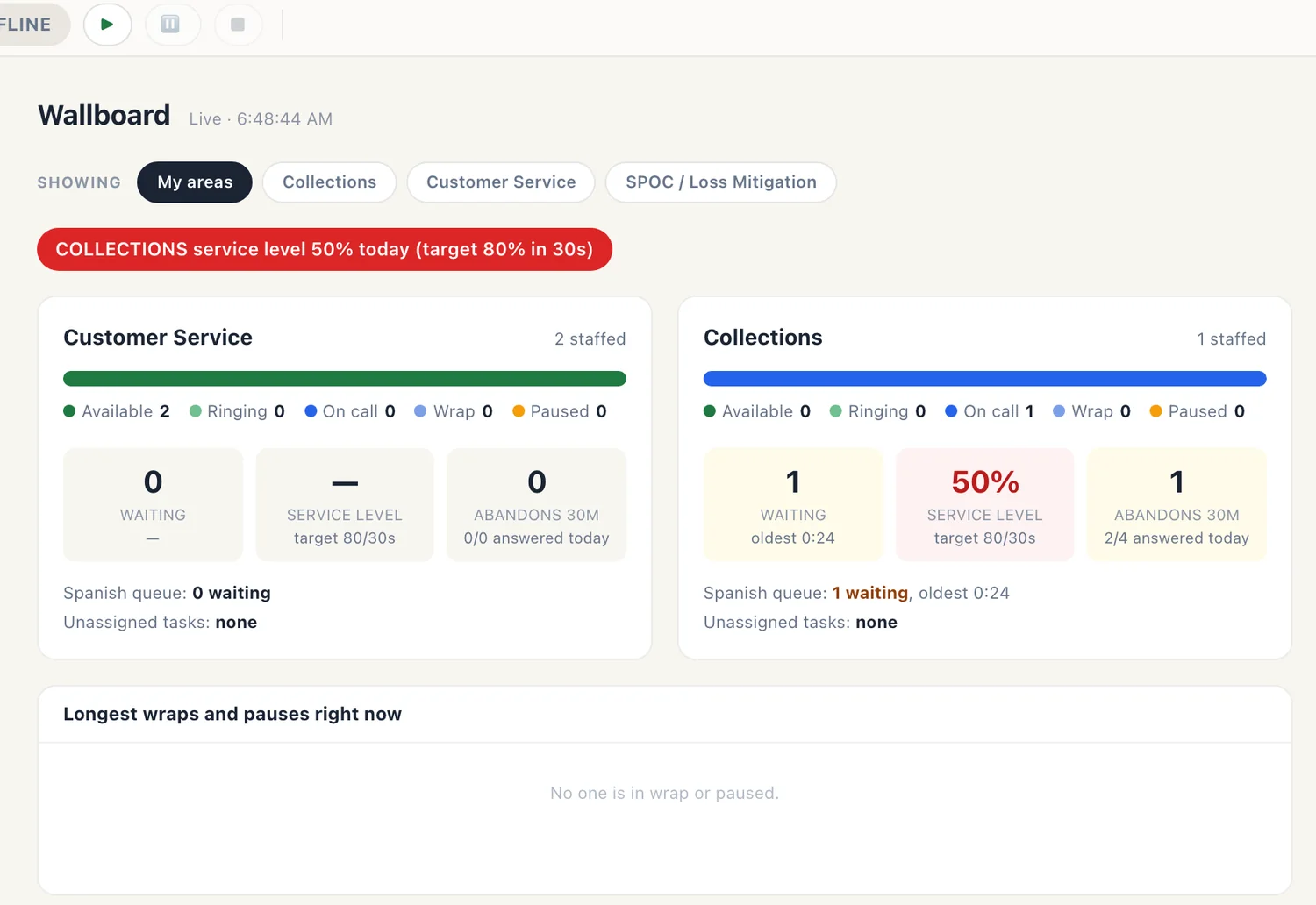
A live wallboard shows agents by state, queue depth and oldest wait per area — Spanish queues called out — and flags service level against target. Behind it, 15-minute agent and queue rollups feed more than 20 standard reports: interval queue performance, agent scorecards, repeat callers, promise-to-pay performance, investor cadence adherence, and compliance controls such as Blocks Honored, the Reg F 7-in-7 monitor and TCPA consent coverage. Reports register in PSP Analytics, where managers can copy or extend them.

Why it matters
  • Supervisors see the floor in real time — who is on a call, in wrap or paused, and who is waiting — without a separate workforce tool
  • Blocks Honored doubles as a control test: attempts made despite an active block should always be zero, and the report shows if they are not
  • Standard reports are ordinary PSP Analytics reports, so a manager builds the next one on the same data sources
Real-Time Operations Reporting
06

Role-Based Panel & Task-Driven Change

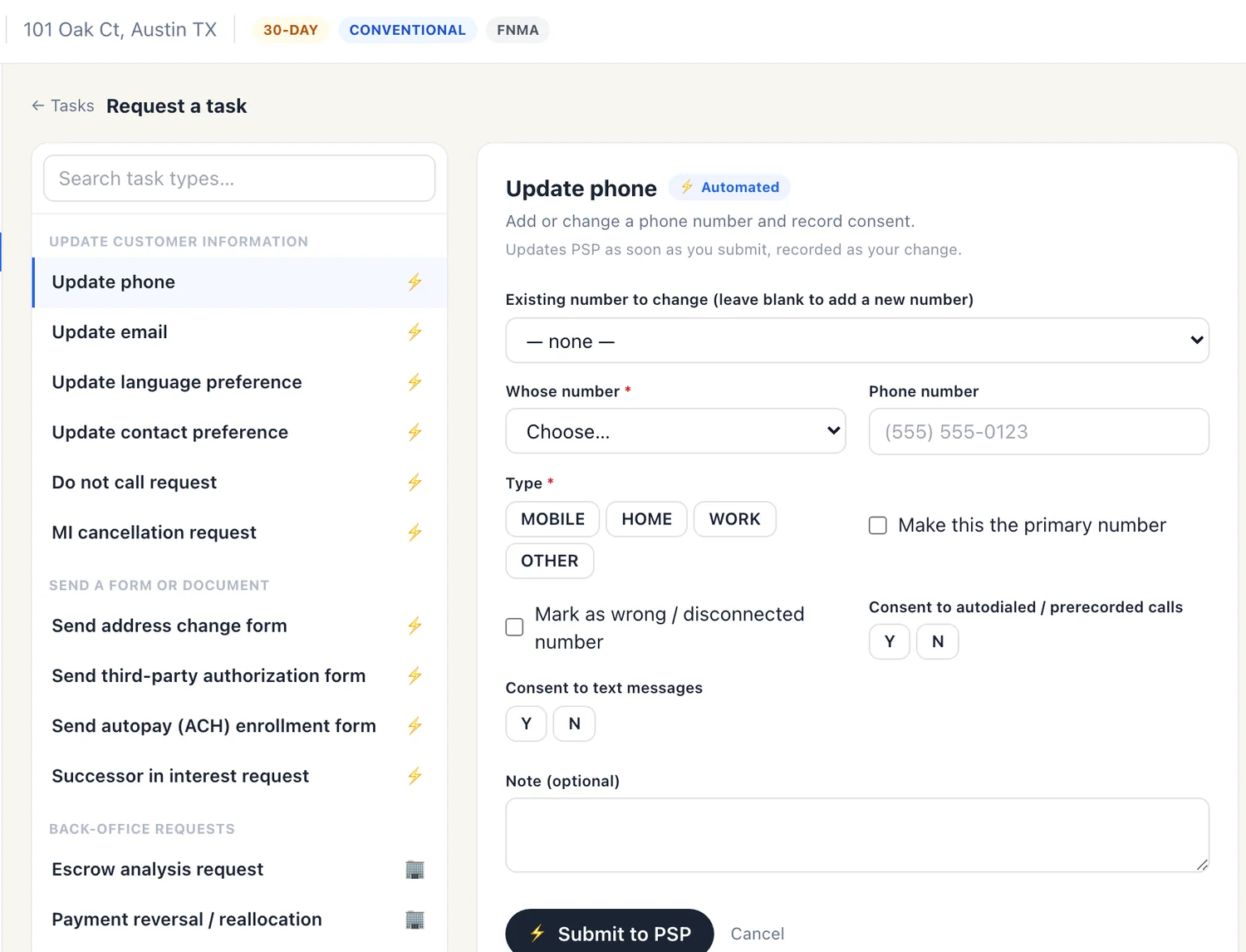
Agents see one shared loan panel — the same one PSP uses — with edit rights set per role and per screen area; in PCS it is read-only except Payments, and edits are disabled rather than hidden. A change to loan data is requested as a task from a configurable catalog — update phone, email or language, do-not-call, send a form, escalate to back office — and the task’s form calls a PSP action attributed to the acting agent or routes to a back-office queue with an SLA.

Why it matters
  • Control is configuration: delegating edit rights to a role — say SPOC but not Customer Service — is a Screen Access change, not a build
  • Every change is a task with an owner, an SLA and an audit trail, and PSP records which agent acted
  • A new request type is a form template plus a task-type row — there is no new screen to build
Role-Based Panel & Task-Driven Change

Built in

Also built into PCS

Beyond the six core capabilities, PCS ships the operating controls a mortgage front office needs on day one.

Call Transfers & Callbacks

Cold or warm transfer to a manager with a reason and note; callback tasks.

End-Call Data & Dispositions

Configurable disposition and resolution codes; one summary note to PSP per call.

AI-Assisted End-Call Notes

Opt-in draft of the note and knowledge search; no phone number, SSN or name is sent to the model.

Maker-Checker Approvals

Optional two-person approval for contact-policy and state-calling-rule changes.

Alerts & Notifications

Service-level, long-wrap and queue alerts through the platform notification service.

State Calling Rules

Hours, Sunday rules and weekly caps for all 50 states, DC and PR, each tracked as reviewed.

Loss-Mitigation Hand-Off

Open loss-mit cases route to the SPOC; LM events create tasks; assisted-application launcher.

Setup Readiness & Promotion

Readiness checklist and export/import to move configuration between environments.

Who it’s for

Who it’s for

Servicers that run the front office on a contact-center platform that knows nothing about mortgages, beside a servicing system that knows nothing about calls.

Servicers on PSPPCS runs inside your Pulsar Servicing Platform instance, sharing its login, rules engine and database — no second core and no second login.
Servicers with Loss MitigationOpen loss-mitigation cases route to the SPOC and LM events create follow-up tasks. PCS also works without LM.
Compliance & risk teamsEdit contact policy, state calling rules and investor cadences as rule sets — with optional two-person approval and a full audit trail.
Contact-center operationsSupervisors see the floor in real time, and your existing contact-center platform and dialer plug in behind a vendor-neutral adapter.

Architecture

Under the hood

How PCS is built

Decision-engine and event-driven by design — contact policy, routing, cadence and task rules are configuration the platform reads, and PCS runs inside PSP rather than beside it.

01PresentationRole-gated screens inside PSP’s single web app
Agent DesktopPhone toolbar, click-to-dial, caller strip, shared loan panel with policy banners, End Call
Supervisor ConsoleWallboard, floor, workload, SPOC balance, 20+ standard reports
Admin ConsoleTeam placement, routing, contact policy, task types, integrations, AI
02API & EventReal time and vendor-neutral
PCS API140+ endpoints, license-gated per organization
Phone HubLive agent-state and call events pushed to every agent and supervisor screen
Outbox & WebhooksDurable PSP actions; HMAC-signed vendor, PSP and Loss Mitigation webhooks
03Decision EnginesAdmin-editable rule sets on live loan facts
Contact PolicyBlocks and warnings, state calling windows, Reg F caps, TCPA consent
Routing & PriorityArea, skills and queue priority from language, DPD, foreclosure, complaint
SPOC CadenceInvestor call cadence creates one task per rule per loan
LM Stage to TaskLoss Mitigation events open SPOC follow-up tasks
04Data & AuditA pcs schema inside PSP’s PostgreSQL database
pcs SchemaAgents, calls, end-call data, tasks, contact attempts, 15-minute rollups
Interaction Event LogAppend-only, with actor and before/after on every configuration change
Retention & ReadinessNightly purge with floors; setup checklist; export/import of configuration
05IntegrationPSP is the system of record
PSP (required)PCS reads it and writes only through audited actions
Loss Mitigation (optional)LM events and SPOC assignment through its public API
Phone System & DialerVendor-neutral adapter; a simulator ships. You keep your dialer lists

Talk to us about Pulsar Customer Service.

Get in touch