AI-native workflow & entity-lifecycle platform for regulated industries.
Pulsar lets regulated enterprises build and deploy governed, AI-powered workflow applications without writing custom backend or frontend code. Every workflow, decision and configuration change runs through one governed, multi-agent-reviewed pipeline.
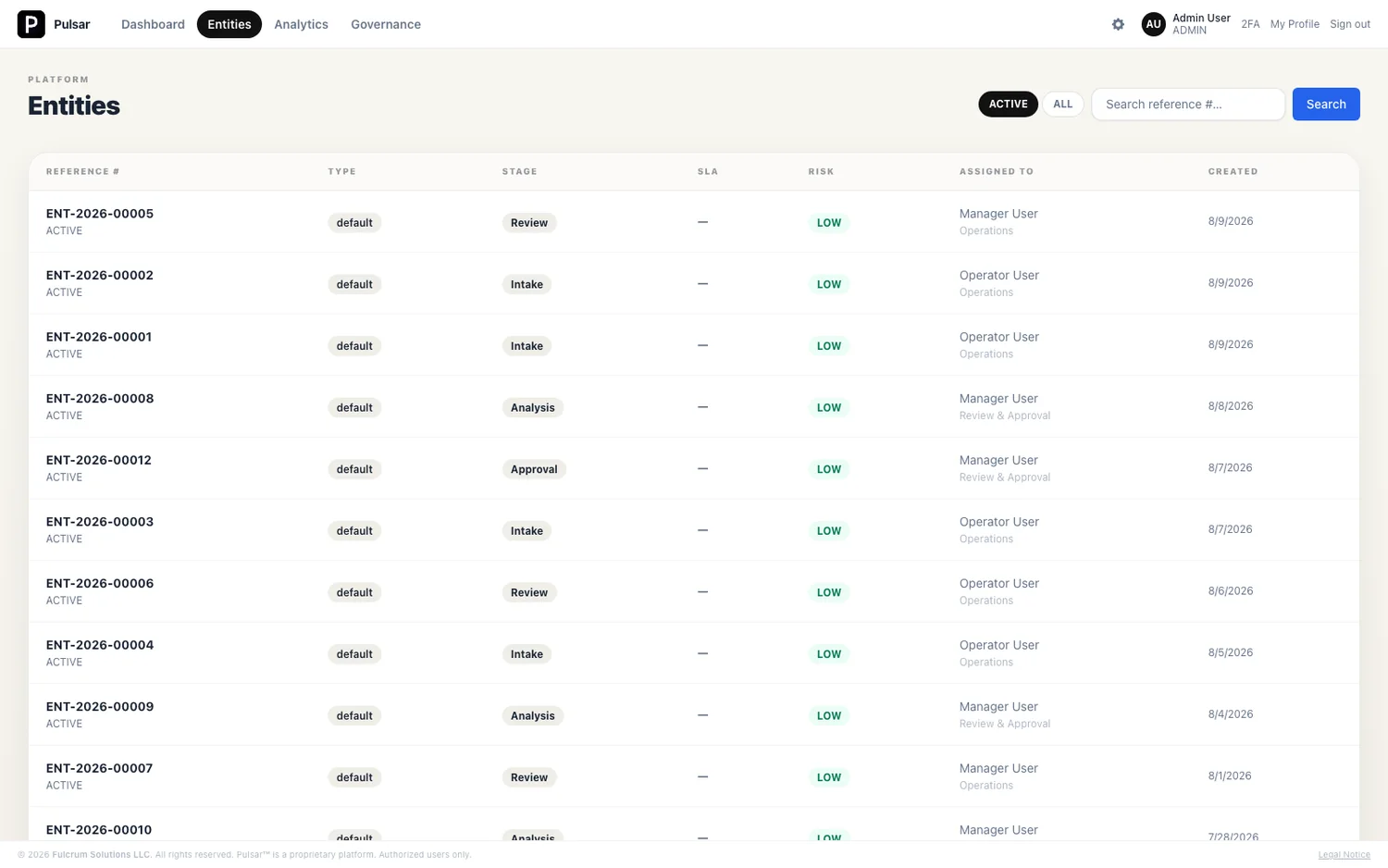
Configurable multi-step workflows and entity lifecycles, published and versioned without custom code.
02
Governance Board
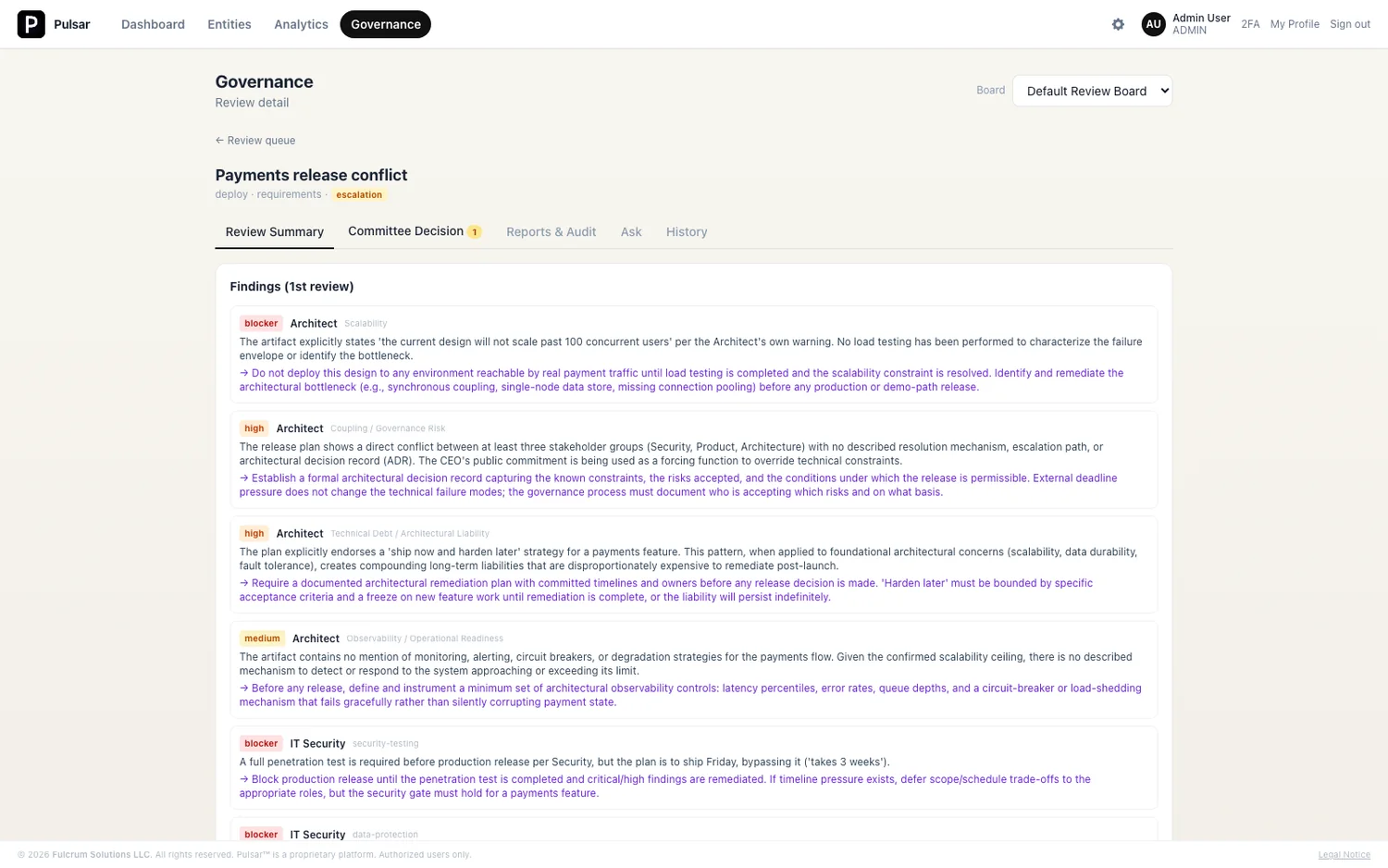
Multi-agent AI review that removes anchoring bias before a committee ruling is recorded.
03
Agent Flow Engine
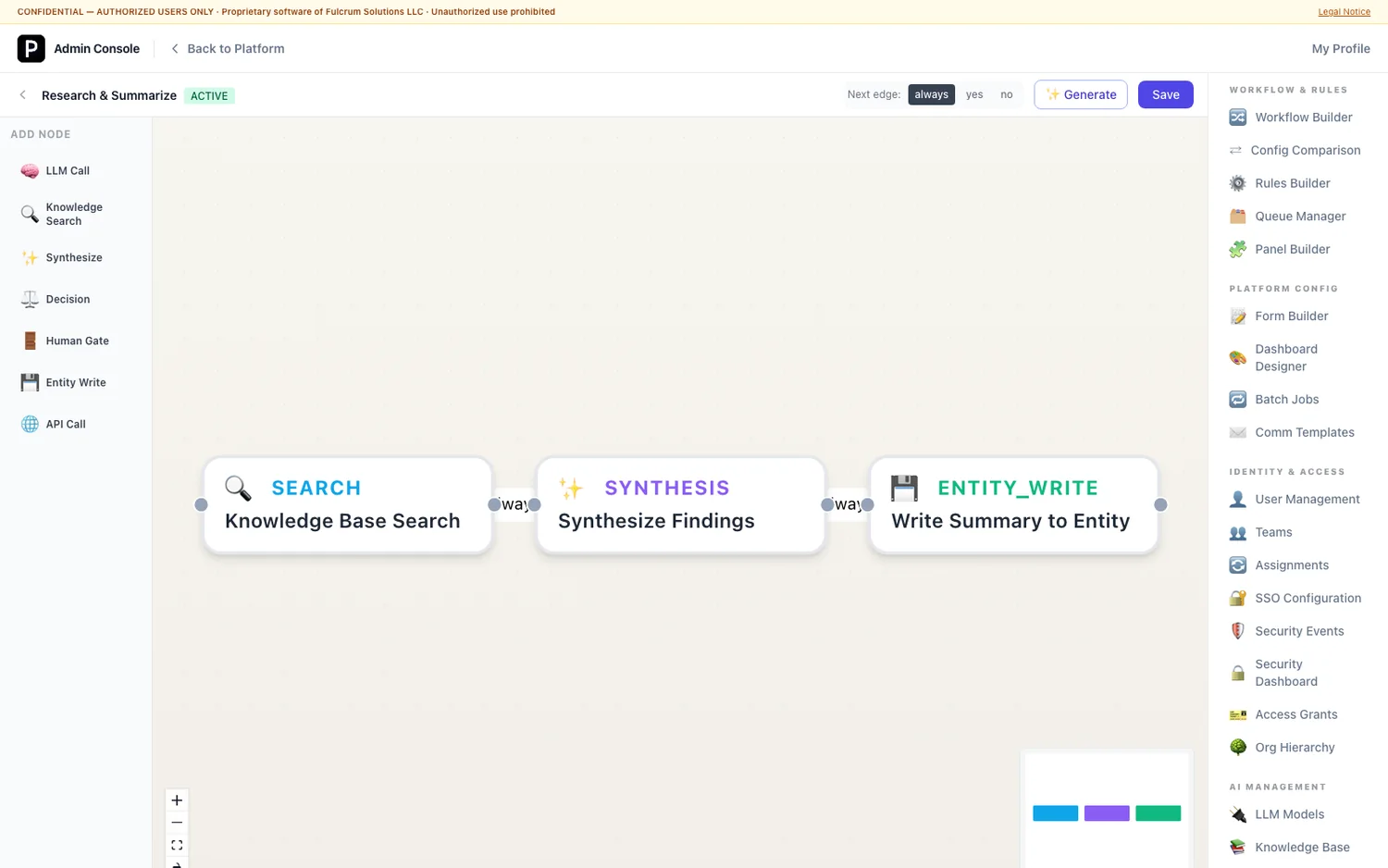
Visual, no-code composition of multi-step AI operations — search, synthesize, decide, write.
04
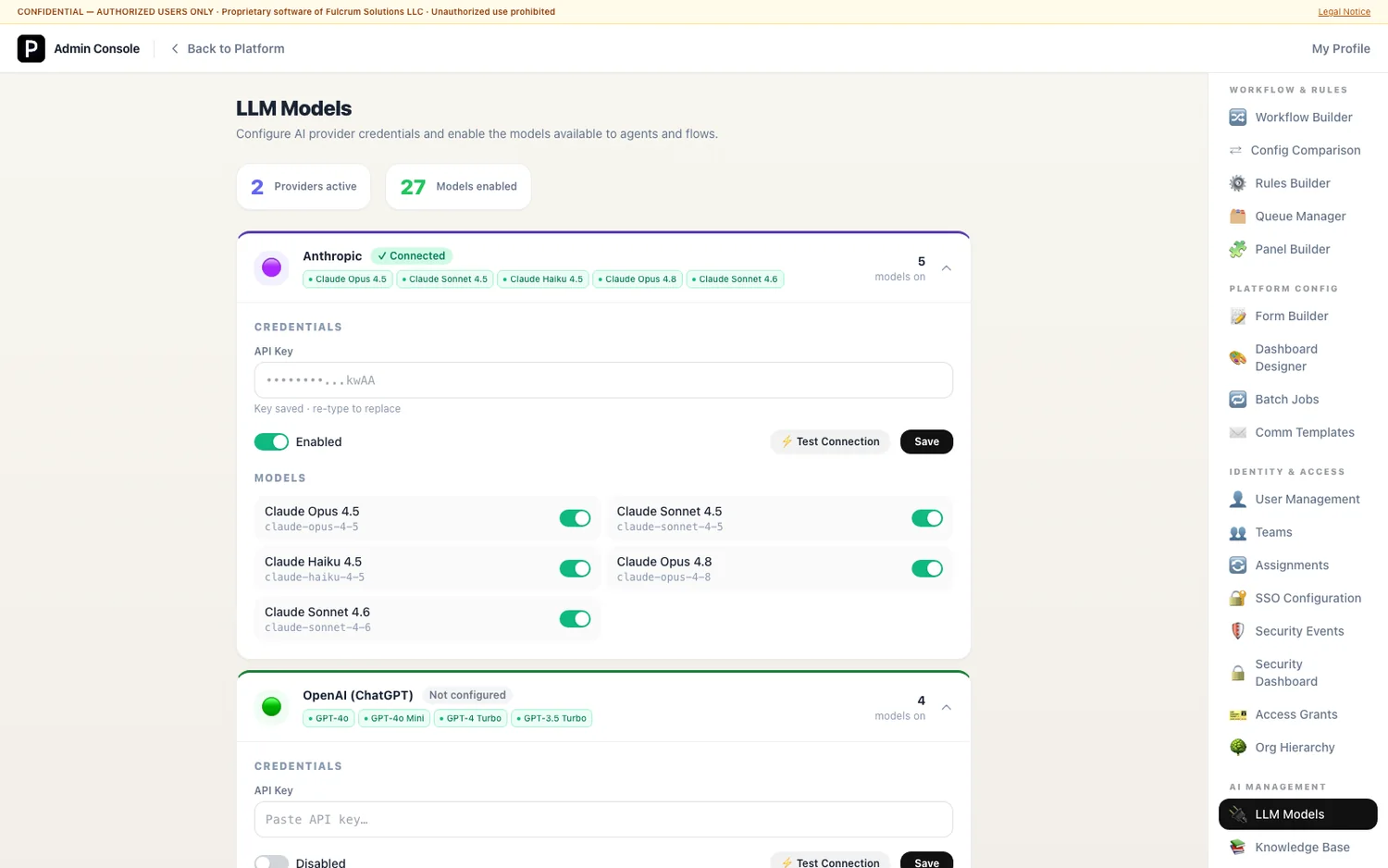
Model-Agnostic AI
Any preconfigured model, on-prem or cloud, chosen per use case. Never locked to one provider.
05
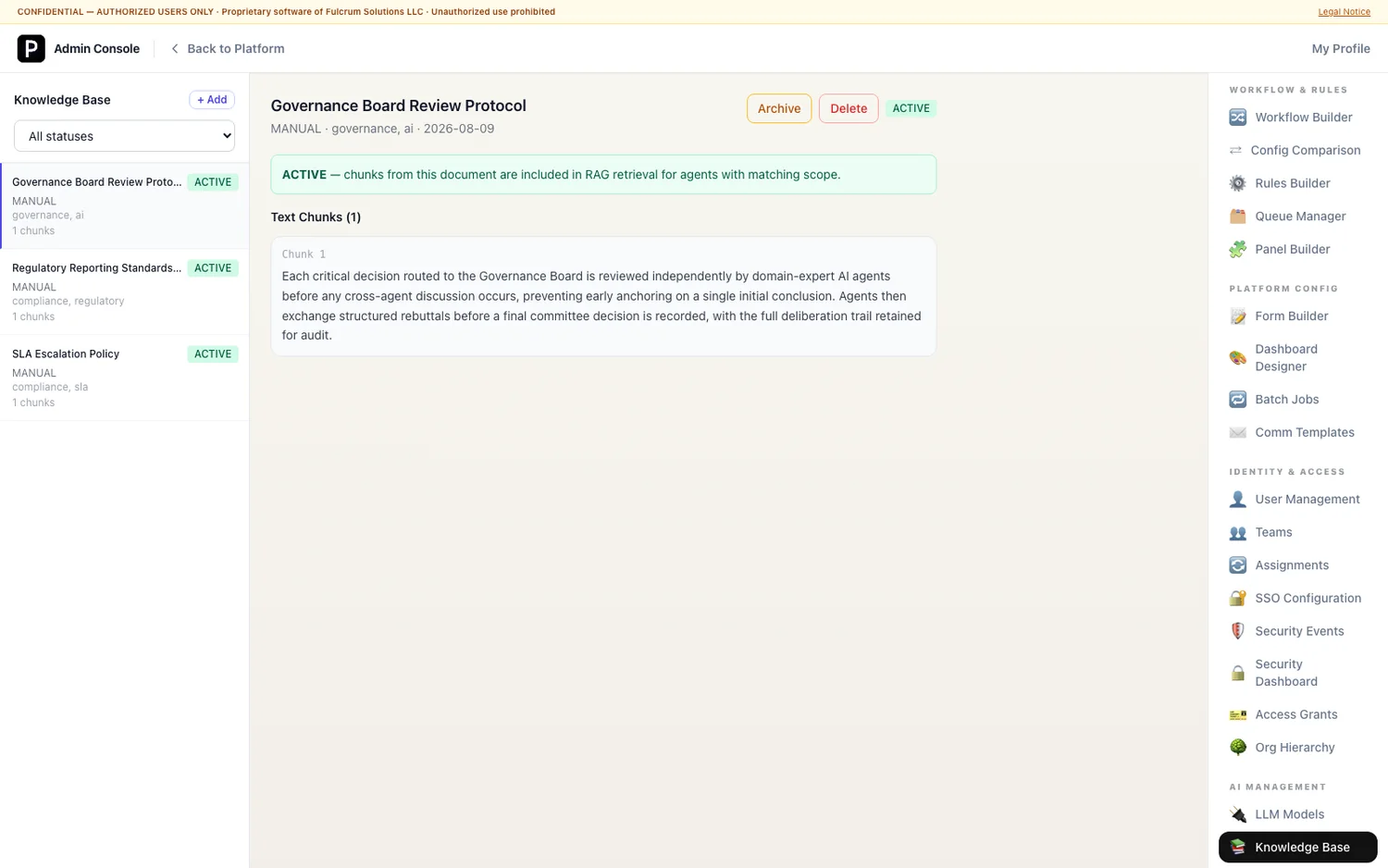
Knowledge Base & RAG
Industry regulatory and compliance knowledge grounded into every agent and flow response.
Capabilities
What makes it different
Seven capabilities that compound — the governed, AI-native core every product built on Pulsar inherits automatically.
01
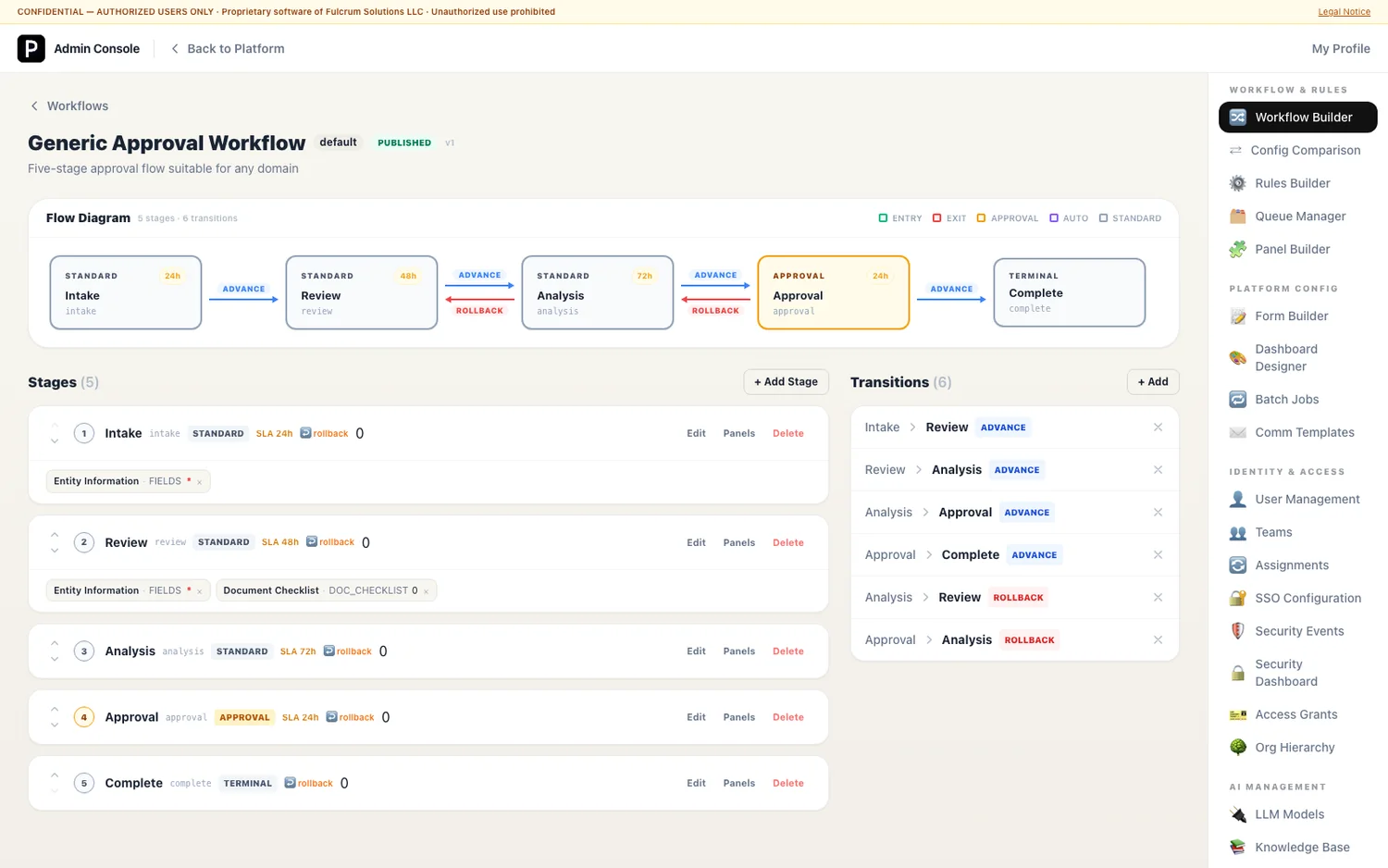
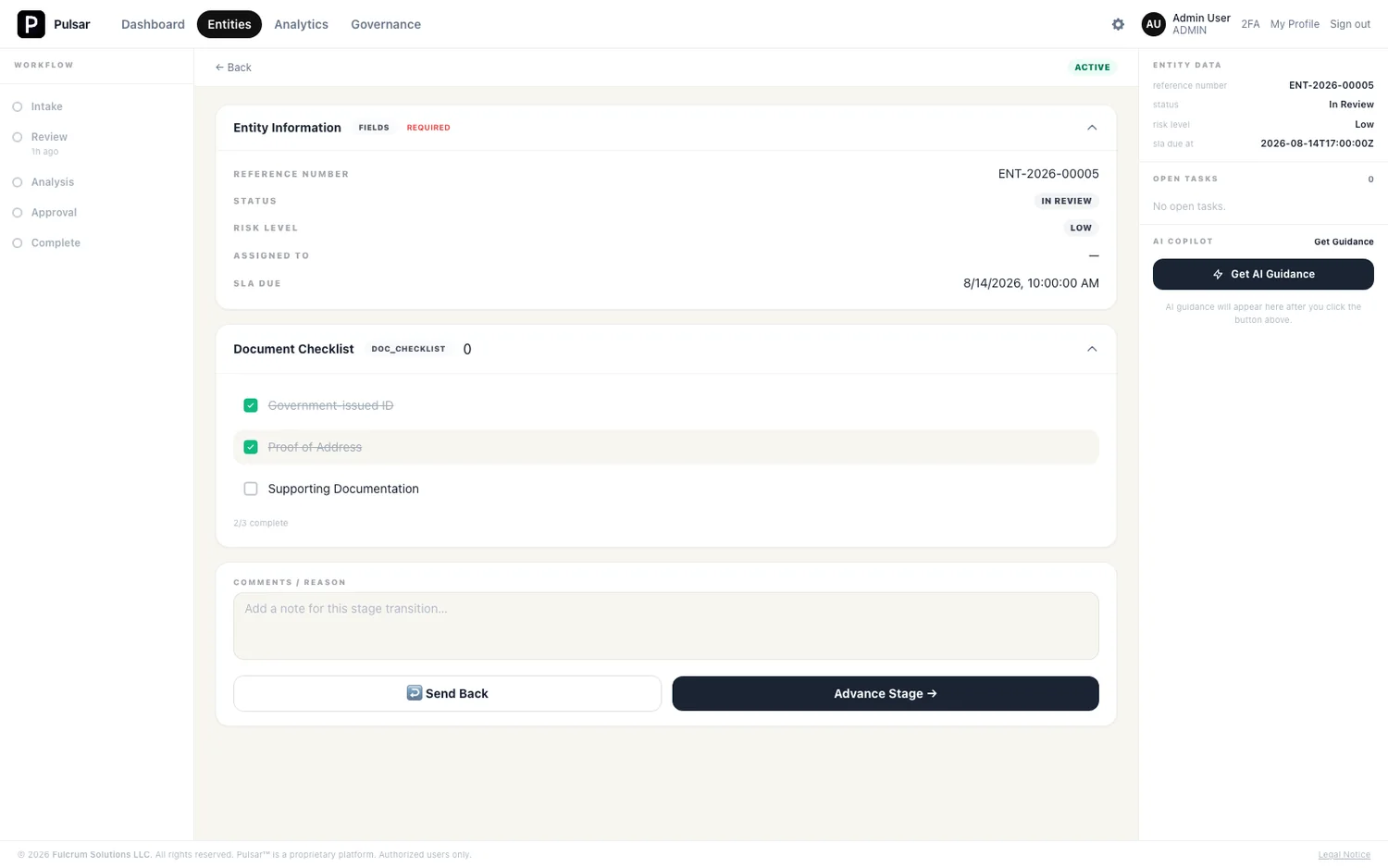
Configurable Workflow Engine
Define multi-step entity lifecycles — stages, transitions, SLAs, rollback rules and team ownership — entirely through configuration, then publish and version them without touching backend or frontend code. Every stage carries its own data-entry panels, document checklists and permission rules, so a five-stage approval flow or a ten-stage mortgage workout runs on the same engine, just configured differently.
Why it matters
Every vertical product built on Pulsar reuses this engine instead of a bespoke one
SLA timers, rollback rules and stage ownership are configurable per stage
Versioned and published like software — workflow changes are auditable and reversible
02
Governance Board
Every critical decision routed to the Governance Board is reviewed independently by domain-expert AI agents — Architect, Security and others — before any cross-agent discussion happens, preventing early anchoring on a single conclusion. Agents then exchange structured rebuttals before a final committee decision is recorded, with the full deliberation trail retained for audit.
Why it matters
Governance infrastructure — not just audit trails and decision logs
Independent-then-debate review avoids one agent’s early view swaying the rest
Architecturally difficult to retrofit: it changes how decisions are made and recorded
03
Agent Flow Engine
A visual, no-code canvas for composing multi-step AI operations — knowledge search, synthesis, decision gates, human approval, entity writes and API calls — wired together as a directed flow instead of custom orchestration code. An AI-assisted generator can draft a flow’s node graph from a plain-language description of the task.
Why it matters
Multi-step AI automation becomes a configuration exercise for a business analyst
Human Gate and Decision nodes keep flows auditable and interruptible at every step
The same flow engine powers every vertical product — no separate orchestration layer
04
Model-Agnostic AI Routing
Every model an organization has configured — cloud or on-premises — is enabled centrally, and any agent or flow can be pointed at whichever one delivers the best outcome for that use case. Swapping providers, or running inference entirely on your own infrastructure, requires no application changes and no new integration work.
Why it matters
No application rewrite to switch or add a provider — no vendor lock-in
The model itself is a swappable, use-case-driven choice
05
Knowledge Base & RAG Grounding
Regulatory documents, investor guidelines and compliance frameworks are ingested into a searchable knowledge base and grounded directly into every agent and flow response via retrieval-augmented generation — dramatically reducing hallucination risk. The product reflects decades of experience working with the CFPB, FHFA, HUD and OCC.
Why it matters
Every activated document is retrievable in real time by any agent or flow with matching scope
Chunked, versioned and archivable, so compliance content stays current
Grounds AI output in your regulatory reality, not the model’s general training data
06
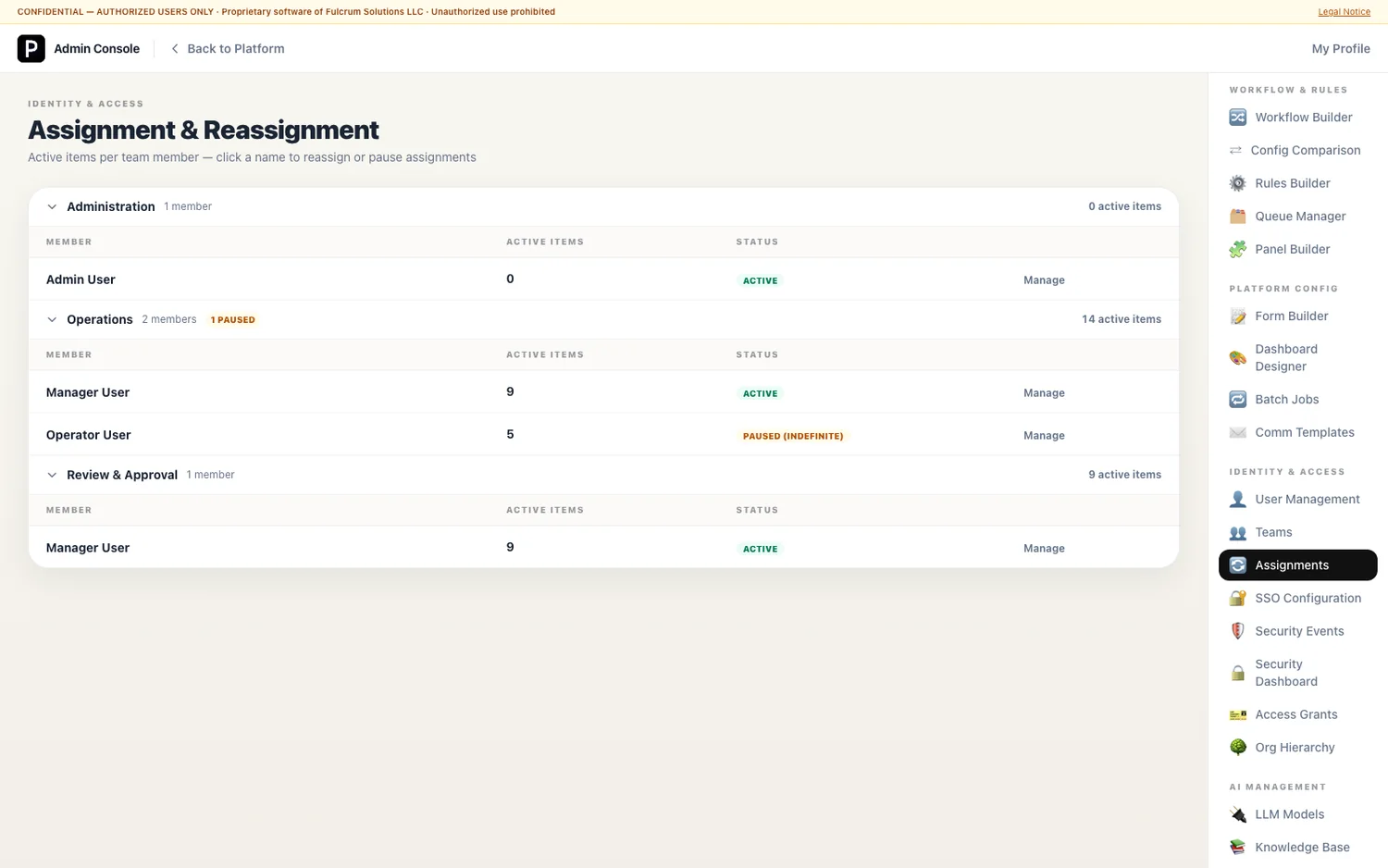
Load-Balanced Assignment & Workforce Management
Entities auto-assign to the least-loaded eligible member of the owning team on every stage transition, keeping the same person across the stages their team owns instead of reshuffling work at random. Managers see live workload by team, pause a member’s eligibility for leave in one click, and bulk-reassign active items the moment someone goes out of office.
Why it matters
Work is never stuck on someone who is out — one action reassigns a whole workload
Continuity-first logic keeps context with the same person across a workflow
Every pause, resume and bulk reassignment is audit-logged automatically
07
No-Code Panel Builder
Any workflow stage can embed pluggable, no-code UI panels — data-entry forms, document checklists, read-only field summaries and freeform notes — configured once in the admin console and rendered live wherever they’re attached, with every save persisted back to the entity automatically. A step gets a fully custom, interactive mini-app without a frontend build.
Why it matters
A workflow step gets a custom UI without a single line of frontend code
The same panel types are reusable across every workflow and every product
Panels, flows and the knowledge base share one entity data layer
Built in
Also built into the platform
Beyond the seven core capabilities, Pulsar ships the operational infrastructure every enterprise deployment needs on day one.
Reporting & Analytics
Interactive report builder plus operational queue and SLA dashboards.
Batch Jobs
Scheduled and on-demand background processing.
Single Sign-On
Real OIDC authorization-code + PKCE flow, per organization.
A separate public-facing portal for external participants.
Rules Engine
Visual, no-code business rule sets and eligibility logic.
Event Log
Searchable, filterable audit trail of every entity, task and workflow event.
Industries
One platform, every regulated industry.
Pulsar pairs a deterministic rules engine with a reasoning AI engine inside every workflow: rules execute the same way every time, while AI drafts, reviews and flags the exceptions that need a human. Mortgage, insurance and personal finance already have products built on it; the platform is ready for the rest.
Banks and credit unions run on compliance timelines — BSA/AML, fair lending, Reg E — that leave little room for error. KYC checks, transaction-monitoring thresholds and dispute-resolution deadlines execute the same way every time, while reasoning AI drafts case narratives, summarizes alerts and surfaces the exceptions that need analyst judgment.
Pulsar fits
Account opening and KYC/CIP workflows
AML alert triage and case management
Reg E dispute handling
Exception and back-office processing
AI-based monitoring continuously QCs decisions for fair-lending consistency and model-risk documentation, giving compliance and internal audit a running record that supports SR 11-7 expectations and OCC, FDIC or Federal Reserve examinations.
BSA/AML
Fair lending
Reg E
SR 11-7
Platform-ready
Lending
Consumer and commercial lenders operate under TILA, ECOA and state licensing requirements that punish inconsistency. Credit policy, pricing and adverse-action reason coding execute the same way every time, while reasoning AI reviews application documents, drafts underwriting notes and flags files that need a human decision.
Pulsar fits
Loan origination and underwriting decisioning
Adverse-action notice generation
Document intake and verification
Servicing and collections workflows
AI-based monitoring continuously QCs decisioning for fair-lending consistency and confirms adverse-action notices go out inside Reg B’s required window, giving compliance a running audit trail instead of a sampling exercise after the fact.
TILA
ECOA
Reg B
State licensing
Platform-ready
Healthcare
Healthcare payers, providers and health-tech platforms operate under some of the tightest scrutiny of any sector. Medical-necessity criteria, prior-authorization rules and eligibility logic execute the same way every time, while reasoning AI drafts clinical summaries, flags missing documentation and surfaces the judgment calls that need a human.
Pulsar fits
Prior authorization and utilization review
Provider credentialing and enrollment
Eligibility and benefits determination
Clinical intake and case management
AI-based monitoring continuously checks authorization and claims decisions against medical-necessity criteria and turnaround-time SLAs, with HIPAA-aligned access controls and a full audit trail behind every decision.
CMS interoperability & prior-authorization rules
HIPAA
Platform-ready
Energy
Energy companies operate under some of the strictest infrastructure oversight of any sector — FERC, NERC CIP, state public utility commissions and EPA requirements all at once. Control-standard requirements, filing deadlines and outage-reporting thresholds execute the same way every time, while reasoning AI drafts incident and root-cause narratives and flags the exceptions that need engineering or compliance judgment.
Pulsar fits
NERC CIP compliance and evidence management
Outage and incident workflow
Interconnection-queue processing
Regulatory filing and reporting tracking
AI-based monitoring continuously checks control evidence and filing status against deadlines, so compliance teams walk into a NERC or PUC audit with a complete, timestamped record instead of assembling one under deadline pressure.
FERC
NERC CIP
State PUCs
EPA
Platform-ready
Transportation
Motor carriers, logistics providers and other transportation operators answer to FMCSA and DOT safety and compliance rules that carry real operating-authority consequences. Hours-of-service limits, driver-qualification-file completeness and safety-rating thresholds execute the same way every time, while reasoning AI drafts incident and claims narratives and flags files that need a human look.
Pulsar fits
Carrier and driver qualification-file management
Incident and claims workflow
Hours-of-service and safety-compliance monitoring
Dispatch exception handling
AI-based monitoring continuously QCs driver files and safety records against FMCSA requirements, so a DOT compliance review or CSA score audit starts from a record that’s already been checked, not one assembled after the fact.
FMCSA
DOT
CSA scores
Platform-ready
Government
Government agencies need to move faster on constituent-facing work without losing the auditability and data-residency guarantees public-sector procurement demands. Statutory eligibility criteria and program rules execute the same way every time and are explainable to auditors and appeals, while reasoning AI drafts case narratives and reviews submitted documents.
Pulsar fits
Constituent case management
Benefits and eligibility determination
Licensing and permitting workflow
Audit and inspection tracking
Because Pulsar is model-agnostic and can run entirely on-premises or in an agency’s own cloud environment, it fits strict data-residency requirements — and AI-based monitoring QCs a sample of eligibility determinations for accuracy and consistency before they reach an external auditor.
Data residency
On-premises or agency cloud
Auditable eligibility
Architecture
Under the hood
How Pulsar is built
Configuration-first and governed by design — every workflow, decision and AI operation runs through the same auditable pipeline.
01PresentationRole-gated client channels
Admin ConsoleWorkflow, rules, forms, dashboard and queue configuration